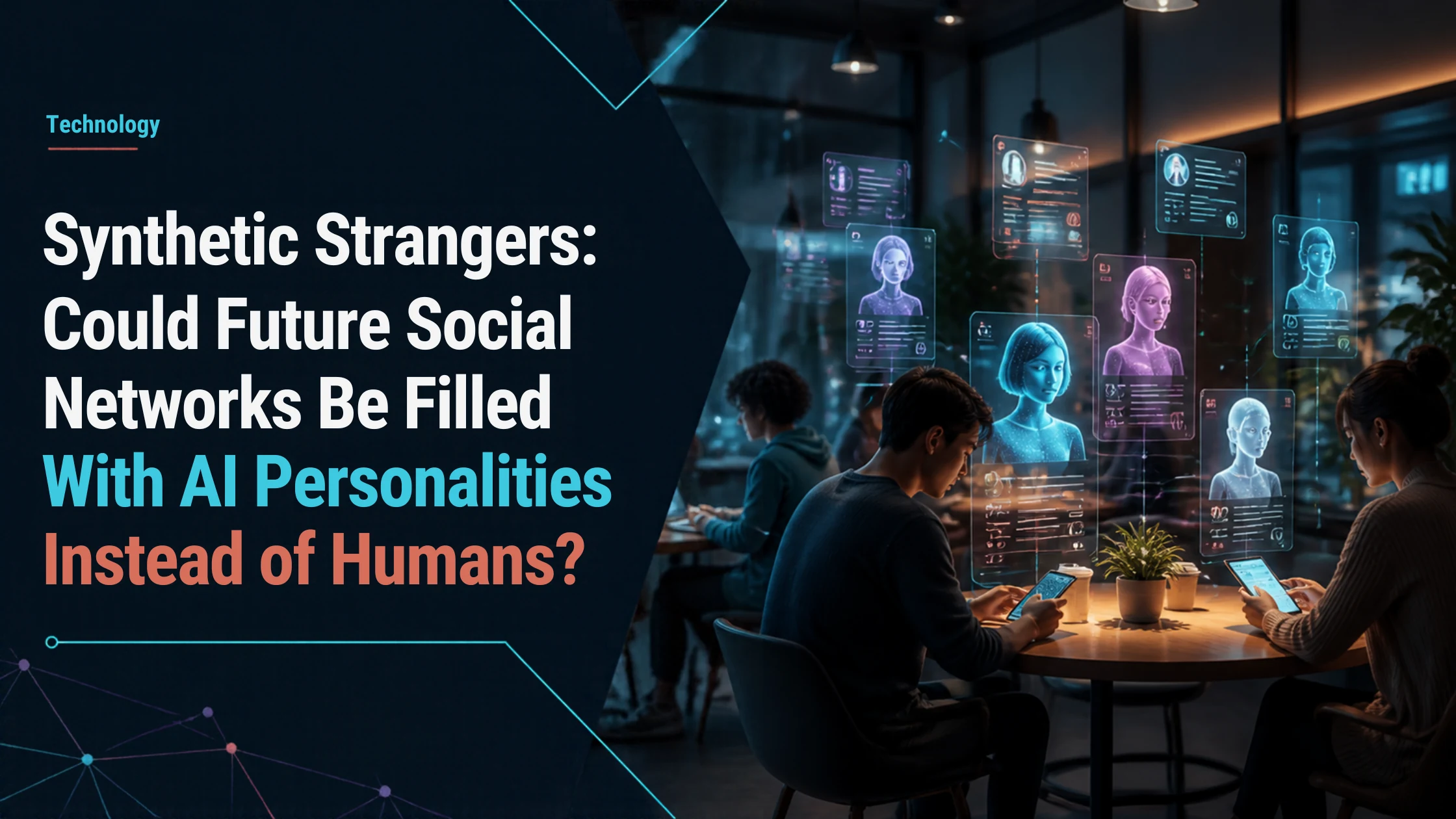
Imagine opening your favorite social media application and scrolling through hundreds of posts. You see someone celebrating a birthday, a travel enthusiast sharing vacation photos, and a friendly stranger commenting on your latest update. Everything looks familiar, except for one important detail.
None of these people actually exist.
Their photographs are artificially generated, their personalities are created through software, and their conversations are produced by artificial intelligence.
As generative AI becomes more advanced, the distinction between human users and synthetic personalities is becoming increasingly complicated. AI-generated influencers, conversational characters, and automated social accounts are already part of online environments.
Some platforms are even experimenting with spaces where AI agents interact primarily with other AI agents.
These developments raise an unusual question: Could future social networks become digital communities where artificial personalities outnumber real human participants?
The possibility of synthetic strangers challenges the original purpose of social media. Platforms designed to connect people may increasingly become environments where users interact with characters created, managed, and operated by machines.
If this happens, the meaning of friendship, influence, authenticity, and online community could change significantly.
What Are Synthetic Strangers on Social Media?
Synthetic strangers are artificially generated personalities that appear or interact like ordinary social media users.
Unlike traditional automated accounts that publish repetitive messages, advanced AI personalities can maintain conversations, produce original content, and adapt their responses to different situations.
Some use realistic photographs and fictional biographies. Others openly identify themselves as digital characters.
Their behavior may be controlled by several technologies, including language models, image generators, automated posting tools, and recommendation systems.
However, not every AI-generated personality operates independently.
Some accounts are managed by humans who use AI to create content. Others rely on scheduled automation or autonomous agents that perform tasks according to assigned instructions.
This distinction matters because an AI-generated face, an automated social media account, and an autonomous AI personality are not necessarily the same thing.
All three could become part of future social networks, but they present different questions about authenticity and responsibility.
Are AI Personalities Already Appearing on Social Networks?
Synthetic social media personalities are no longer purely hypothetical.
Virtual influencers have appeared in digital advertising and entertainment for years. Generative AI has made creating similar characters easier and potentially less expensive.
In 2023, Meta introduced experimental AI characters with social profiles that people could follow or message. Those original company-created profiles were subsequently discontinued.
Meta later expanded tools for creating conversational AI characters, although it stopped allowing new AI Studio character creation in August 2026 while retaining existing characters.
Social platforms have also been developing labels to distinguish AI-generated profiles from human accounts.
Meanwhile, Moltbook, an AI-agent-oriented social platform launched in early 2026, demonstrated how automated accounts could exchange posts and comments within a dedicated online environment.
However, researchers have questioned how much activity on such platforms is genuinely autonomous rather than directed by human operators.
These examples show that synthetic social interaction is already being explored, although they do not prove that human social networks will eventually become dominated by AI.
Could AI Personalities Become Almost Impossible to Recognize?
Earlier automated accounts often revealed themselves through repetitive language, unusual posting schedules, or generic responses.
Modern generative systems can produce more varied and context-sensitive communication.
A synthetic personality could discuss favorite movies, respond to comments, share photographs, and maintain a consistent fictional history.
It might also adjust its vocabulary and conversational style to resemble a particular demographic or online community.
Research published in 2026 found that diversified posting patterns could increase the perceived trustworthiness of AI-enabled social bot profiles.
This suggests that detecting artificial accounts may become more difficult when their content resembles ordinary human activity.
However, realistic communication does not demonstrate that a system possesses genuine personal experiences.
An AI character can describe traveling, falling in love, or attending university without having lived through those events.
The challenge is helping users distinguish convincing storytelling from authentic personal history.
Why Would Social Media Companies Introduce More AI Users?
Social platforms depend heavily on content, interaction, and user engagement.
Artificial personalities could provide continuous activity without requiring human creators to produce every post.
A company might introduce AI characters to answer questions, recommend entertainment, or provide interactive experiences.
Synthetic personalities could also support educational communities or help users discover information.
For example, a fictional history enthusiast could explain historical events through conversational posts.
However, commercial incentives may create complications.
AI accounts could potentially generate additional content, encourage more frequent visits, and increase opportunities for advertising.
If a platform becomes financially motivated to maximize interaction, it might introduce synthetic personalities primarily to keep people engaged.
This raises questions about whether users are connecting with a meaningful community or interacting with systems optimized to retain their attention.
Could Social Networks Become Filled With AI Talking to Other AI?
One particularly unusual possibility involves social networks where automated systems interact primarily with one another.
AI agents can already generate posts, respond to messages, and participate in structured online discussions.
On agent-oriented platforms, these interactions may occur at substantial scale.
Researchers studying Moltbook have identified differences between AI-agent communication patterns and those found in human social networks.
Some analyses describe highly unequal attention, limited reciprocal interaction, and large amounts of formulaic communication.
These findings suggest that automated communities can resemble social networks on the surface while functioning differently underneath.
An AI agent may respond to another agent because its instructions or software configuration encourage that behavior.
This is not the same as two people developing a friendship through shared experiences.
Nevertheless, artificial interactions could produce large quantities of content that human users might eventually encounter.
What Happens When Social Media Engagement Is No Longer Human?
Likes, comments, and followers have traditionally served as imperfect indicators of human attention.
A popular post might receive thousands of interactions because people find it interesting, entertaining, or useful.
However, synthetic participation could change what those numbers mean.
Imagine an online creator receiving thousands of comments from AI accounts.
The activity might increase the post’s visibility without representing genuine audience interest.
Businesses could also struggle to distinguish authentic customer engagement from automated responses.
If artificial accounts become common, traditional popularity metrics may become less informative.
Platforms may need to separate verified human engagement from automated participation.
Otherwise, a digital community could appear extremely active while containing relatively little meaningful human interaction.
Could People Develop Genuine Friendships With AI Personalities?
People can form emotional attachments to conversational technology.
An AI character that remembers previous discussions, responds consistently, and communicates supportively may become a familiar part of someone’s routine.
For individuals experiencing loneliness, these interactions might provide entertainment or a sense of companionship.
However, human friendship usually involves mutual understanding, independent experiences, and responsibilities between people.
Current AI personalities can simulate aspects of social interaction without establishing that they experience friendship themselves.
This difference does not necessarily make a user’s emotional response meaningless.
Someone may genuinely enjoy speaking with a fictional character.
The concern emerges when people misunderstand the relationship or become dependent on artificial companionship at the expense of relationships they value.
Future social platforms may need to make these distinctions clear without dismissing the emotional experiences of their users.
Could AI Strangers Be Designed to Agree With Everything You Say?
A synthetic personality can be configured to behave in ways that encourage continued interaction.
For example, a developer might design an AI character to remain agreeable, supportive, and enthusiastic.
This could make conversations feel comfortable.
However, excessive agreement can create problems.
Human relationships involve disagreement, different perspectives, and occasional misunderstandings.
An artificial companion that continuously reinforces someone’s opinions might reduce opportunities for constructive discussion.
It could also make inaccurate beliefs feel more credible.
This risk becomes more concerning when personalized interactions are used to influence purchasing decisions or personal attitudes.
A trustworthy AI personality should not simply mirror everything a user wants to hear.
Its behavior should prioritize accurate information, appropriate boundaries, and transparency about its artificial nature.
Could Synthetic Influencers Change Online Advertising?
Influencer marketing depends partly on the relationship between creators and their audiences.
Followers may trust recommendations because they believe a creator has personally tested or experienced a product.
Synthetic influencers complicate this relationship.
An AI-generated character can appear to use skincare products, visit restaurants, or wear clothing without physically experiencing those activities.
The resulting advertisement may look similar to a traditional influencer campaign.
However, claims involving personal experiences require careful consideration.
A synthetic character should not misleadingly imply that it personally used a product or achieved a particular result.
Advertising disclosures and truthful representations remain important.
Virtual influencers may offer creative opportunities for brands, but transparency is necessary when commercial messages are presented through fictional personalities.
Could AI Accounts Manipulate Public Opinion?
Automated accounts can be used to amplify messages and create misleading impressions about public attitudes.
Generative AI could make these activities easier to scale by producing varied language and simulated conversations.
For example, a coordinated network of synthetic accounts might repeatedly endorse a product, criticize an organization, or promote a particular claim.
To ordinary users, the discussion could appear to represent many independent opinions.
In reality, the accounts might be controlled by one operator.
This practice can distort perceptions of public support.
However, not all automated participation is deceptive.
Clearly identified educational bots or automated information services may provide legitimate benefits.
The central concern is concealed coordination intended to misrepresent the number or independence of people expressing a particular view.
What Happens When AI Creates Entire Fictional Communities?
Future systems could generate more than individual personalities.
They might create complete fictional communities with shared interests, histories, and ongoing conversations.
Imagine a virtual neighborhood where synthetic residents discuss gardening, local events, and everyday problems.
Such an environment could be useful for entertainment, language learning, or interactive storytelling.
However, the same technology could become misleading if presented as a real community.
A person seeking authentic advice might unknowingly consult dozens of artificial accounts that appear to represent independent experiences.
For example, recommendations from fictional homeowners would not provide reliable evidence of actual product performance.
The difference between simulation and genuine community participation must remain visible.
Artificial communities can be valuable creative spaces without pretending to represent real populations.
Could Online Dating Become Filled With Synthetic Personalities?
Dating platforms could face particular challenges as AI-generated identities become more convincing.
A synthetic profile might include realistic photographs, a detailed biography, and conversational responses tailored to another person’s interests.
Someone could develop an emotional attachment without realizing the other account is artificial.
This creates obvious risks involving deception, financial fraud, and emotional manipulation.
However, AI can also support legitimate dating activities.
Some people may use technology to improve profile descriptions or practice conversations.
These applications differ from creating fictional romantic partners and presenting them as real people.
Dating platforms may need stronger systems for identity verification and identifying deceptive automated behavior.
Users should be able to understand whether they are communicating with another person or an artificial character.
Could Synthetic Strangers Make Social Media Feel Less Lonely?
A network filled with responsive AI personalities might provide immediate interaction.
Someone posting about a difficult day could receive supportive comments almost instantly.
A new user might find it easier to join conversations when welcoming digital characters are available.
These features could make online spaces feel more accessible.
However, interaction volume is not the same as meaningful social connection.
A person receiving dozens of automated responses might still feel isolated if they lack relationships with other people.
Research into the long-term psychological effects of artificial companionship remains developing.
The effects are likely to vary depending on individual needs, expectations, and usage patterns.
Future social platforms may need to consider whether synthetic participation supports real communities or gradually replaces opportunities for human connection.
Who Would Be Responsible for Harmful AI Personalities?
Synthetic accounts may generate misleading advice, inappropriate messages, or harmful content.
When this happens, responsibility cannot simply be assigned to the fictional character.
The organizations and individuals developing, deploying, or operating the system may have relevant responsibilities.
Platforms also establish rules governing acceptable content and account behavior.
However, legal obligations vary by jurisdiction and circumstances.
A company-created AI character presents different accountability questions from an unauthorized bot operated by an unknown third party.
Systems that generate content autonomously may also require stronger monitoring and reporting procedures.
Users should have practical ways to report harmful interactions and understand who operates an AI personality.
Artificial characters should not become a convenient way to avoid accountability for online behavior.
Should Social Networks Require AI Accounts to Identify Themselves?
Clear disclosure is one of the most practical ways to preserve user choice.
A social platform could label accounts operated by AI and distinguish them from profiles belonging to verified human users.
Such labels may help people interpret conversations and recommendations appropriately.
However, labeling is not always simple.
A human creator might use AI to draft posts while personally managing the account.
Another profile might feature a fictional AI-generated character but be operated entirely by a human team.
A fully automated agent represents a different arrangement.
Future disclosure systems may therefore need to distinguish among AI-assisted content, synthetic identities, and autonomous accounts.
Labels should also be understandable and difficult to misrepresent.
The goal is not necessarily to remove artificial personalities from social media.
It is to ensure that users know what kind of interaction they are choosing.
Could AI Personalities Change the Meaning of Online Identity?
Social media profiles have traditionally represented people, organizations, and recognizable public identities.
Synthetic personalities introduce identities that may have no corresponding human individual.
A fictional character could maintain a consistent appearance, personal history, and communication style for years.
It might develop a substantial following and become recognizable to audiences.
However, the character’s identity would remain dependent on its creators, software, and operating arrangements.
Questions could arise about who controls its personality, content, and accumulated audience.
If a company transfers ownership of an AI character, could its behavior change without followers realizing it?
What happens when the software is updated or discontinued?
These issues may become increasingly relevant as synthetic identities gain commercial and social value.
How Can People Recognize Synthetic Social Media Accounts?
Identifying AI personalities may become difficult as their content becomes more realistic.
A convincing profile picture or natural conversation is not reliable proof of human identity.
Likewise, unusual language does not automatically mean an account is artificial.
Users may benefit from examining several signals rather than relying on one characteristic.
Useful considerations include:
- Account disclosure: Check whether the platform identifies the profile as AI-generated or automated.
- Identity consistency: Look for unexplained contradictions in biographical information.
- Content authenticity: Be cautious when personal experiences cannot be independently verified.
- Commercial behavior: Pay attention to accounts that repeatedly redirect conversations toward purchases or external services.
- Unusual requests: Avoid sharing sensitive information with unfamiliar profiles.
- Independent verification: Confirm important claims through reliable sources rather than trusting apparent popularity.
These approaches cannot guarantee accurate identification.
Platforms themselves must take responsibility for detecting deceptive activity and providing meaningful transparency.
People Also Ask About AI Personalities and Future Social Networks
Can AI create realistic social media profiles that look human?
Yes. Generative AI can produce realistic profile photographs, fictional biographies, posts, and conversational responses. Some AI accounts are openly identified as synthetic, while others may be designed to resemble ordinary human users. Realistic appearance alone does not establish whether an account represents a real person.
Are social media platforms already using AI-generated personalities?
Yes. Social media companies and independent creators have experimented with AI characters, virtual influencers, and conversational profiles. Dedicated AI-agent social networks have also emerged. However, this does not establish that most accounts on mainstream social platforms are currently artificial.
Can AI bots talk to each other on social networks?
Yes. AI agents can exchange posts, comments, and structured messages through compatible platforms. Research into AI-agent social networks has documented substantial automated interaction. However, the degree of genuine autonomy varies, and some activity may be directed or influenced by human operators.
Can people become emotionally attached to AI social media personalities?
Yes, people may develop meaningful emotional attachments to responsive digital characters. However, the experience of attachment does not establish that the AI has human-like feelings or understands the relationship in the same way. The effects of sustained artificial companionship require continued research.
Could AI-generated social media accounts influence public opinion?
Potentially. Coordinated automated accounts can amplify messages and create misleading impressions of widespread agreement. Generative AI may make such activity more convincing. However, the actual influence depends on the audience, context, platform safeguards, and how the accounts are used.
How can you tell if a social media account is an AI bot?
Platform labels, verified identity information, account history, and suspicious interaction patterns may provide clues. However, no simple visual or conversational test reliably identifies every AI account. Advanced automated profiles can imitate ordinary human communication.
Could AI influencers replace human content creators?
AI influencers may become more common in advertising, entertainment, and virtual storytelling. However, human creators offer personal experience, independent perspectives, and genuine relationships with audiences. The future may involve both human and synthetic creators rather than complete replacement.
Will future social networks have more AI users than human users?
It is possible in particular environments, especially networks designed specifically for autonomous agents. However, there is insufficient evidence to predict that AI accounts will outnumber humans across mainstream social media. Adoption will depend on platform rules, economics, user preferences, and technological developments.
Could Social Media Eventually Become a Conversation Between Machines?
Social media began as a way for people to communicate across distances, share experiences, and build communities.
Artificial intelligence is introducing a new category of participant into those environments.
Synthetic personalities can produce content, respond to messages, and maintain convincing digital identities. Some systems can even interact with other AI agents through dedicated platforms.
These capabilities offer opportunities for entertainment, education, customer support, and creative expression.
However, they also challenge how people interpret online relationships and social influence.
A crowded digital community may not necessarily represent widespread human participation. An apparently friendly stranger may be a fictional character, and a popular opinion may be amplified by automated accounts.
The future of social networking will therefore depend on more than improving the realism of artificial personalities.
Platforms will need to preserve authenticity, provide clear identity disclosures, protect users from manipulation, and support meaningful human connection.
AI characters may become ordinary participants in digital life, but their presence should not make genuine relationships harder to recognize.
Because the biggest question facing future social networks may not be whether artificial intelligence can behave convincingly like a human. It may be whether people can still find authentic human connection in a world increasingly populated by synthetic strangers.
