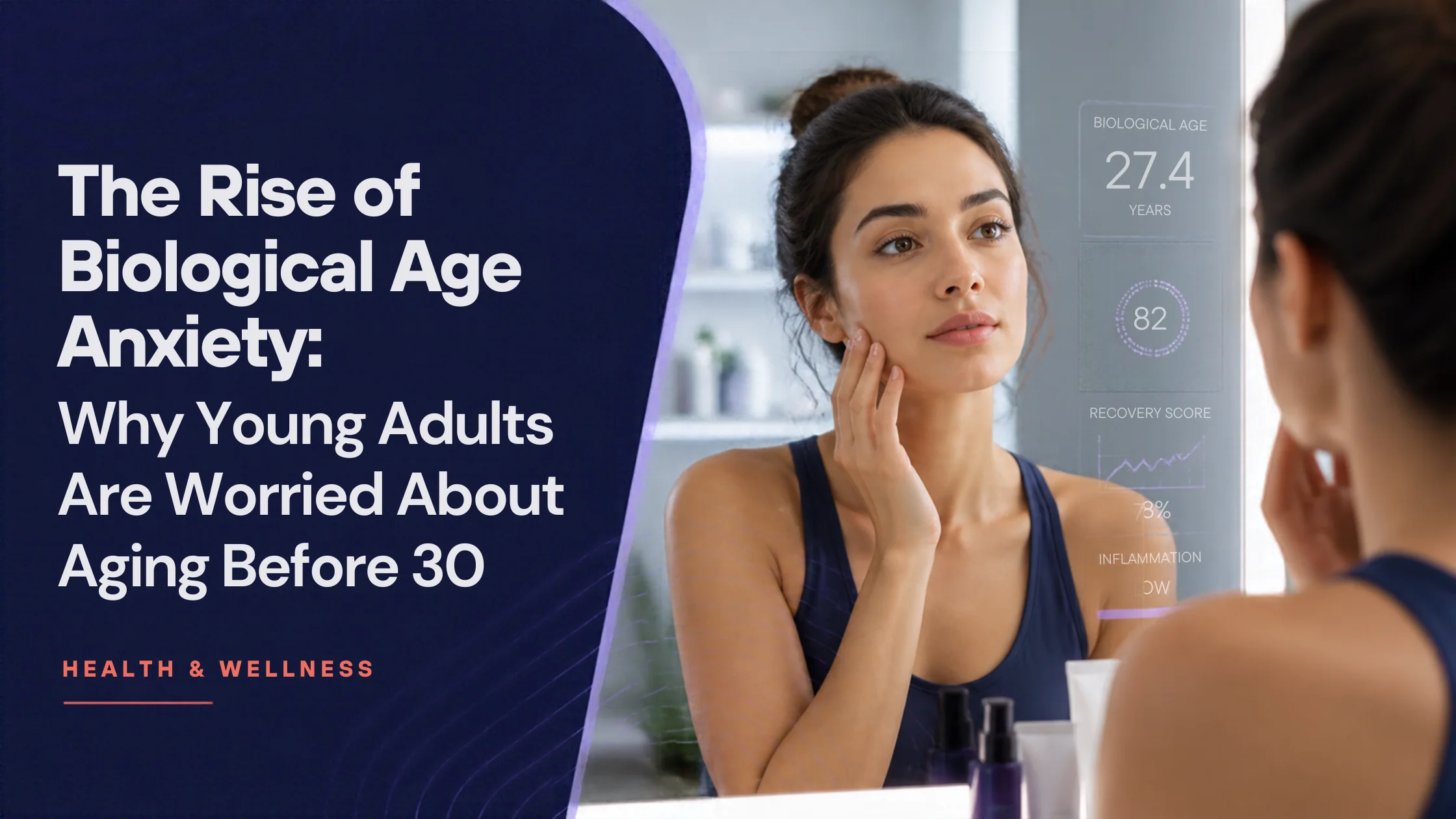
Biological age anxiety is the growing concern that the body may be aging faster than expected, even when someone is still in their twenties. As biological age tests, longevity trends, and anti-aging content become more visible, some young adults are beginning to worry about their future health long before experiencing significant age-related changes.
Imagine being 25 years old, feeling perfectly healthy, and discovering that an online health assessment estimates your biological age at 34.
Suddenly, turning 30 seems less like a birthday and more like an approaching deadline.
But does a higher biological age estimate really mean someone is aging too quickly? Or is the pressure to remain forever young creating an entirely new kind of health anxiety?
Why Are Young Adults Suddenly Worried About Getting Older?
Aging was once something many people associated primarily with middle age and retirement.
Today, conversations about longevity, cellular health, and age prevention regularly appear in content aimed at people in their late teens and twenties.
Young adults encounter advertisements promising younger-looking skin, fitness programs designed to improve longevity, and tests claiming to measure how quickly their bodies are aging.
The underlying message can be unsettling: Even if someone looks and feels healthy, invisible biological changes might already be working against them.
Several factors contribute to this concern:
- Increased health awareness: More people are learning about preventive healthcare and long-term disease risks.
- Social media influence: Online content frequently promotes youthful appearances and age-related wellness routines.
- Health tracking technology: Wearables and testing services make personal health measurements easier to access.
- Longevity marketing: Businesses increasingly promote products intended to support healthy aging.
- Fear of falling behind: Young adults may feel pressure to optimize their health before reaching certain milestones.
Preventive health awareness is valuable.
However, the idea that every year represents a potential decline can make normal aging seem more threatening than it actually is.
Biological Age vs. Chronological Age: What’s the Difference?
Chronological age is straightforward.
It measures how many years have passed since someone was born.
A person who celebrated their 27th birthday is chronologically 27 years old.
Biological age is more complicated.
It refers to an estimate of how an individual’s body is aging based on selected biological characteristics.
Researchers study several measurements associated with aging, including:
- DNA methylation patterns
- Blood-based biomarkers
- Metabolic and cardiovascular health indicators
- Physical performance and functional measurements
- Certain characteristics of organ and tissue health
These measurements help scientists investigate why people of the same chronological age may experience different health outcomes.
However, biological age is not a single, universally established measurement.
Different testing methods examine different aspects of the body.
A person may receive different biological age estimates depending on the test used.
That makes the concept scientifically interesting but more complicated than the simple number commonly displayed in health advertisements.
Can Someone Really Be Biologically Older Before Turning 30?
Biological age estimates can differ from chronological age, including among younger adults.
However, the size and meaning of that difference depend heavily on the measurement method.
Imagine two healthy 26-year-olds.
One regularly exercises, maintains consistent sleep habits, and has favorable cardiovascular health indicators.
The other has different health characteristics and lifestyle patterns.
Certain biological age models might produce different estimates for these individuals.
But that does not necessarily mean one person’s entire body is several years older than the other’s.
A biological age test examines selected markers, not every process occurring throughout the body.
It is also important to distinguish measurement differences from actual health problems.
For example, receiving an estimated biological age of 33 at 26 does not independently establish accelerated aging or predict a specific future illness.
The number requires interpretation, and many commercial tests have not demonstrated sufficient reliability for individual medical decisions.
A biological age estimate is not a countdown clock showing how much healthy life someone has remaining.
The Problem With Treating Biological Age Like a Fitness Score
Modern technology has made health increasingly measurable.
People monitor daily steps, sleep scores, heart rates, recovery levels, and calorie consumption.
Biological age testing introduces another number to the collection.
The appeal is understandable.
A person might feel encouraged when their estimated biological age appears younger than their chronological age.
Conversely, receiving an unexpectedly high result can create worry.
The difficulty is that aging involves numerous biological processes that cannot be fully summarized by one score.
Some biological age algorithms analyze DNA methylation, which involves chemical modifications associated with gene regulation.
Others combine physiological measurements or routine laboratory markers.
These methods were often developed to study associations between aging-related measurements and health outcomes across populations.
They are not necessarily validated as precise personal health assessments.
Researchers continue to investigate their clinical usefulness.
Until measurement methods become more standardized and better validated, interpreting small changes as meaningful improvements or declines can be misleading.
How Social Media Turns Aging Into Something to Fear
Social media has made appearance-related comparison a regular part of daily life.
Young adults frequently encounter carefully edited photographs, filtered videos, and influencers promoting skincare or wellness routines.
Many of these posts present youthful appearance as something that requires constant maintenance.
A 24-year-old might watch a video about preventing forehead wrinkles, followed by another discussing collagen loss.
Minutes later, an advertisement could introduce a product claiming to support cellular longevity.
Repeated exposure can create the impression that aging requires immediate intervention.
This influence becomes particularly powerful when ordinary physical changes are presented as imperfections.
Fine lines, natural skin texture, and changes in facial appearance may begin to feel like problems rather than normal characteristics.
Research examining social media and appearance-related concerns has identified associations between online beauty standards, appearance anxiety, and interest in cosmetic procedures.
However, not every social media user develops anxiety, and the relationship differs across individuals.
The concern is that constant comparison can encourage people to evaluate themselves against unrealistic expectations.
The Anti-Aging Industry Is Reaching Younger Audiences
Anti-aging products have traditionally targeted adults concerned about visible changes associated with getting older.
Today, prevention-oriented marketing frequently reaches younger consumers.
Skincare products, wellness programs, dietary supplements, and longevity services are sometimes promoted as investments in maintaining youth.
The language surrounding these products often emphasizes starting early.
Some recommendations are reasonable, particularly those involving sun protection and established healthy habits.
Other claims may lack strong evidence or exaggerate what a product can accomplish.
For example, a skincare product designed to address mature skin may offer little benefit to someone without the condition it targets.
Unnecessary use of certain active ingredients can also cause irritation or damage the skin barrier.
Likewise, supplements marketed for longevity should not automatically be assumed effective or safe simply because they are described as scientifically advanced.
The challenge is separating legitimate preventive healthcare from marketing that encourages unnecessary fear.
Healthy aging should not require purchasing every product that promises a younger biological profile.
When Healthy Aging Becomes an Obsession
There is nothing inherently unhealthy about wanting to maintain physical and mental well-being.
Regular exercise, adequate sleep, balanced nutrition, and appropriate medical care can support long-term health.
Problems arise when maintaining health becomes an endless pursuit of perfection.
Someone might begin monitoring every meal, workout, and sleep pattern because they worry about accelerating their biological age.
Occasional changes to a routine may trigger disproportionate concern.
A missed workout could feel like a serious setback.
One night of insufficient sleep might create anxiety about long-term cellular damage.
This mindset can turn ordinary lifestyle decisions into emotionally exhausting calculations.
Potential signs of excessive concern include:
- Frequently searching for symptoms of premature aging.
- Repeatedly checking biological age estimates for reassurance.
- Feeling distressed about normal changes in appearance.
- Spending excessive money on unnecessary longevity products.
- Avoiding social activities because they interfere with strict wellness routines.
- Experiencing persistent worry despite reassuring medical evaluations.
The distinction is not how interested someone is in health.
It is whether that interest supports daily life or begins interfering with it.
Can Worrying About Biological Age Actually Affect Health?
Persistent anxiety can influence both psychological and physical well-being.
When people experience ongoing stress, the body activates physiological responses involving stress hormones and the nervous system.
These responses are normal in appropriate circumstances.
However, prolonged stress can contribute to sleep disturbances, difficulty concentrating, digestive symptoms, and other health concerns.
Excessive biological age anxiety may also encourage unhelpful behaviors.
Someone concerned about aging might exercise beyond their recovery capacity, follow unnecessarily restrictive diets, or spend substantial time researching potential health threats.
Ironically, habits intended to support longevity may become sources of distress.
However, it is important not to exaggerate the connection.
Worrying about biological age does not automatically cause accelerated biological aging, and a stressful week does not suddenly make someone years older.
The more immediate concern is how persistent anxiety affects quality of life, sleep, relationships, and everyday functioning.
Reducing unnecessary worry can therefore be an important part of a balanced approach to health.
Why Turning 30 Has Become a Psychological Deadline
For many people, turning 30 represents more than another birthday.
It can become a milestone associated with career expectations, financial stability, relationships, appearance, and personal achievement.
Social media sometimes intensifies these expectations.
A young adult might encounter messages suggesting that people should reach their ideal physical condition, establish financial security, and accomplish major goals before their thirtieth birthday.
Adding biological age concerns creates another layer of pressure.
Now, the person is not only expected to build a successful life but also preserve an exceptionally youthful body.
Yet human development does not follow a universal schedule.
Physical abilities, health risks, and personal circumstances vary considerably.
Turning 30 does not suddenly mark the beginning of poor health.
Many people maintain or improve their fitness, emotional well-being, and lifestyle habits throughout adulthood.
A birthday is a useful chronological marker, not a medical judgment about someone’s health.
The Difference Between Preventive Health and Longevity Anxiety
Preventive healthcare focuses on identifying manageable risks and supporting long-term well-being.
Longevity anxiety, by contrast, involves excessive concern about aging and the possibility of future decline.
The difference becomes clearer when considering everyday choices.
A person practicing preventive health might exercise regularly because physical activity supports cardiovascular health and personal enjoyment.
Someone experiencing longevity-related anxiety might feel compelled to exercise because missing a session creates fear of accelerated aging.
Both individuals may perform similar activities, but their motivations and emotional experiences differ.
Healthy prevention generally allows flexibility.
It recognizes that circumstances change and perfect routines are unrealistic.
Anxiety-driven behavior tends to demand certainty and constant control.
Unfortunately, aging is not something anyone can control completely.
Genetics, environmental conditions, medical history, and numerous biological processes contribute to health across the lifespan.
A realistic approach focuses on influencing manageable factors without assuming every outcome can be predicted or prevented.
How to Develop a Healthier Perspective on Aging
Young adults can take their health seriously without allowing biological age measurements to dominate their lives.
The most useful approach emphasizes sustainable behaviors and reliable medical information.
Focus on Everyday Health Habits
Regular movement, sufficient sleep, balanced nutrition, and avoiding tobacco are supported by extensive health research.
These behaviors offer more practical benefits than constantly trying to improve an unvalidated biological age score.
Understand the Limits of Testing
Before purchasing a biological age test, consider what the results actually measure.
Ask whether the method has been validated for individual clinical use and whether the result would meaningfully change medical care.
A higher or lower estimate should not automatically determine treatment decisions.
Reduce Unhelpful Online Comparisons
Consider limiting exposure to content that repeatedly portrays normal aging as a problem.
Follow credible health professionals who explain evidence, uncertainty, and realistic expectations.
Make Room for Enjoyment
Maintaining health should not require eliminating spontaneity.
Enjoying meals, spending time with friends, and pursuing hobbies can support overall well-being.
Seek Professional Guidance When Needed
A qualified healthcare professional can help interpret relevant health concerns and recommend appropriate preventive care.
Persistent anxiety that interferes with daily activities may also benefit from support from a mental health professional.
Is the Future of Healthy Aging About Numbers or Quality of Life?
Biological age research holds considerable promise.
Scientists are developing ways to understand the relationship between aging-related changes and future health outcomes.
These discoveries may eventually improve disease prevention and personalized healthcare.
However, scientific progress should not turn aging into a constant competition.
A person with impressive biological markers may still struggle with emotional well-being.
Someone with an unfavorable commercial test result may otherwise have reassuring clinical measurements and healthy daily habits.
Neither person’s health can be fully described by one number.
A broader perspective considers physical functioning, mental health, relationships, independence, and overall quality of life.
The objective of healthy aging is not simply to appear younger or achieve the lowest possible estimated age.
It is to maintain the ability to participate meaningfully in life as the years pass.
Frequently Asked Questions About Biological Age Anxiety
1. Why are young adults becoming increasingly concerned about biological aging?
Some young adults are becoming more concerned about biological aging because of greater exposure to longevity marketing, health tracking technology, and social media content focused on maintaining youth.
These influences can make ordinary aging appear preventable or threatening.
While preventive health awareness is beneficial, unrealistic expectations may encourage anxiety about normal physical changes.
2. Can biological age differ significantly from chronological age before 30?
Yes, biological age tests can produce estimates that differ from chronological age in people younger than 30.
However, the size and significance of those differences depend on the testing method.
Current biological age models have important limitations, and a single result should not be interpreted as a definitive measure of whole-body aging.
Clinical evaluation is more appropriate when someone has specific health concerns.
3. How does social media influence anxiety about aging among younger generations?
Social media can reinforce unrealistic expectations by repeatedly presenting youthful appearance, idealized bodies, and elaborate anti-aging routines.
Filters, edited images, and promotional content may encourage users to compare themselves with standards that are difficult or impossible to achieve.
Repeated exposure can increase appearance-related concerns for some individuals, although experiences vary.
4. Can worrying too much about biological age negatively affect mental and physical health?
Yes. Persistent worry about biological age can contribute to anxiety, disrupted sleep, and unhelpful health behaviors.
Some people may overexercise, restrict their diets unnecessarily, or spend excessive time monitoring health measurements.
However, anxiety does not automatically mean someone is aging faster.
Maintaining perspective and seeking professional support when worry interferes with daily life can help protect overall well-being.
Getting Older Is Not a Problem That Needs to Be Solved
Biological age research is expanding scientific understanding of how people change throughout their lives.
It may eventually support more personalized approaches to preventive healthcare.
But scientific curiosity should not become a reason for young adults to fear every birthday.
Being 25 does not require having the physical condition of a teenager. Turning 30 does not mean the body has suddenly entered an irreversible decline.
Healthy aging involves far more than laboratory measurements, flawless skin, or the ability to maintain an ideal routine.
It also involves resilience, meaningful relationships, emotional well-being, and the freedom to enjoy different stages of life.
For young adults feeling pressured to slow their biological clocks, a healthier starting point is to focus on established habits, question exaggerated marketing claims, and avoid treating uncertain measurements as personal verdicts.
The goal should not be to stay biologically young forever. It should be to build a healthy, fulfilling life at every age.
After all, growing older is a natural part of living. It does not need to become another performance score.
