AI assistants are increasingly capable of managing emails, scheduling appointments, purchasing products, and completing financial transactions on behalf of users. However, when an AI system makes a costly mistake, responsibility generally remains with the people or organizations involved in developing, deploying, authorizing, or operating it. The precise legal consequences depend on the circumstances, applicable laws, and contractual agreements.
Imagine asking your AI assistant to find an affordable flight, only to discover it purchased a nonrefundable business-class ticket.
Or worse, imagine it accidentally sends confidential business documents to the wrong recipient.
The assistant performed the action, but who pays for the mistake?
As AI systems gain more independence, this question is becoming one of the most important challenges in digital accountability.
The Rise of AI Assistants With Their Own Digital Identities
Traditional digital assistants were relatively limited.
They could answer questions, set reminders, play music, and perform simple commands.
Today, more advanced AI agents can interact with websites, retrieve information, use connected applications, and complete multistep tasks.
Some operate through dedicated digital identities that allow organizations to recognize and manage their activity.
These identities may include authentication credentials, access permissions, assigned roles, and records of previous actions.
For example, a business could assign an AI assistant permission to access customer inquiries, update appointment schedules, and prepare invoices.
The system may perform these tasks using its own machine credentials or delegated access associated with an authorized user.
This creates a new relationship between technology and responsibility.
Previously, a human employee might complete a transaction using a company account.
Now, an AI agent may perform the same action without a person reviewing every step.
The digital identity helps establish which system performed an action. However, it does not automatically determine who is legally responsible.
What Does Having a Digital Identity Actually Mean for AI?
A digital identity allows a system to be recognized within a technological environment.
For humans, digital identities often involve usernames, passwords, authentication methods, and account information.
AI agents can use similar mechanisms.
However, their identities serve a different purpose.
An AI agent’s digital identity may establish:
- Identification: Which automated system is requesting access.
- Authentication: Whether the system can prove it is the authorized agent.
- Authorization: What information or actions the system is permitted to access.
- Activity records: Which operations the system performed.
- Delegated authority: Which person or organization permitted the agent to act.
These elements help organizations monitor automated activity.
For example, a company could determine that its invoice-processing agent approved a particular payment at a specific time.
But digital identification should not be confused with legal personhood.
An AI assistant having credentials does not mean it possesses the same legal standing as a human being or registered corporation.
A digital identity identifies the system performing an action. It does not automatically make the system legally responsible for that action.
Who Is Legally Responsible When an AI Assistant Makes a Costly Mistake?
There is no universal rule assigning responsibility for every AI-generated mistake.
Legal liability may depend on negligence, contractual obligations, consumer protection requirements, privacy laws, and other rules relevant to the transaction.
Several parties may be involved.
The Person Using the AI Assistant
A user who authorizes an AI agent to perform certain activities may bear responsibility for actions properly carried out within that authorization.
For example, someone who instructs an assistant to purchase a product may remain responsible for the transaction.
However, the situation becomes more complicated if the agent purchases something materially different from what was authorized.
The Business Deploying the System
Organizations that use AI to communicate with customers or perform operational tasks may be responsible for how those systems function.
A company generally cannot assume that using automated software eliminates its existing legal obligations.
The AI Developer or Technology Provider
Developers and vendors may face responsibility when harm arises from defective products, misleading claims, inadequate security, or violations of applicable laws.
Whether liability applies depends on the particular facts and legal framework.
Third-Party Service Providers
Additional organizations may become involved when an AI system operates through external payment platforms, cloud services, or connected applications.
Contracts and technical responsibilities can influence how disputes are resolved.
In some situations, responsibility may be shared among multiple parties.
The crucial question is not simply who created the AI assistant, but who owed a legal duty, what went wrong, and whether the mistake caused compensable harm.
When an AI Chatbot Gives the Wrong Information: A Real Legal Example
One widely discussed example involves Air Canada and an incorrect response from its customer service chatbot.
In 2024, British Columbia’s Civil Resolution Tribunal considered a dispute involving a passenger who relied on the airline’s chatbot for information about bereavement fares.
The chatbot incorrectly indicated that a discounted fare could be requested after travel.
The passenger followed that information, but the airline later refused the requested adjustment.
Air Canada argued that it should not be responsible for the chatbot’s inaccurate response.
The tribunal rejected that argument and found the airline responsible for the misleading information provided through its website.
The decision required compensation for the passenger.
Although this was a specific Canadian small-claims decision rather than a universal rule governing all AI systems, it illustrated an important principle.
A business may remain accountable for information communicated through the automated tools it chooses to operate.
Simply explaining that a chatbot made the mistake may not be enough to avoid responsibility.
Can AI Assistants Be Held Accountable Without Human Supervision?
AI assistants can operate with varying degrees of autonomy.
Some require confirmation before every important action.
Others can complete predefined workflows independently.
However, operational independence does not necessarily create independent legal responsibility.
Under current mainstream legal frameworks, AI assistants are generally treated as technological systems rather than separate legal persons capable of bearing ordinary contractual or civil liability in their own names.
A company might allow its AI agent to negotiate prices, approve routine refunds, or organize customer transactions.
If the system acts incorrectly, the company may still face legal or contractual consequences.
The absence of immediate human supervision does not automatically remove responsibility from the organization deploying the technology.
In fact, granting an automated system extensive authority without appropriate safeguards may create additional questions about reasonable care.
The more consequential the decisions, the more important it becomes to establish appropriate oversight.
The Difference Between AI Autonomy and Human Authorization
One of the most important distinctions involves what an AI assistant was actually permitted to do.
Consider two fictional situations.
In the first, a business owner tells an AI assistant to order office supplies up to a specified monthly budget.
The assistant purchases ordinary supplies within those limits.
In the second, the assistant purchases expensive equipment that exceeds the approved budget.
The first situation involves an action apparently consistent with the assigned authority.
The second raises questions about authorization, system controls, and whether the vendor should have recognized the transaction as outside permitted limits.
Investigating such incidents may require examining:
- The original instructions provided to the AI.
- The system’s documented permissions.
- The specific actions it performed.
- Whether approval was required.
- Whether a technical malfunction or external manipulation occurred.
- The contracts and laws governing the transaction.
This distinction becomes essential as AI agents gain greater access to financial and business systems.
A system being technically capable of completing an action does not necessarily mean it was authorized to perform it.
What Happens When an AI Assistant Makes an Expensive Purchase?
Imagine telling an AI shopping assistant to find a laptop under $1,000.
Instead, it purchases a model costing $2,500.
The user might argue that the purchase exceeded the instructions.
The seller may respond that the transaction was completed through an authenticated account.
Meanwhile, the AI provider may point to the service’s terms and operating limitations.
Resolving the dispute could depend on whether the purchase was authorized, applicable cancellation and consumer protection rights, payment rules, and the service provider’s conduct.
The practical consequences become more significant when AI agents manage subscriptions, travel reservations, business purchases, or investment-related workflows.
Organizations can reduce these risks by establishing transaction limits and approval requirements.
An assistant might be allowed to research products and prepare orders while requiring human confirmation before payment.
Such arrangements preserve convenience without granting unrestricted purchasing authority.
How Digital Identity Changes Accountability
Digital identity becomes especially important when multiple AI agents operate within one organization.
Imagine a company using separate agents for customer service, accounting, inventory, and marketing.
Each system interacts with different applications.
If an unauthorized payment occurs, investigators need to establish which agent performed the action and whose authority it used.
Without reliable identification, it may be difficult to reconstruct events.
A well-designed identity system can help answer important questions.
Which agent accessed the financial system? Which credentials did it use? What permissions were active? Was the action connected to an approved request?
In 2026, the U.S. National Institute of Standards and Technology explored these challenges in work addressing software and AI agent identity and authorization.
Key considerations include authentication, delegated permissions, access restrictions, and reliable auditing.
These measures can improve accountability.
However, recording an AI agent’s activity does not automatically resolve the legal question of who must compensate someone harmed by that activity.
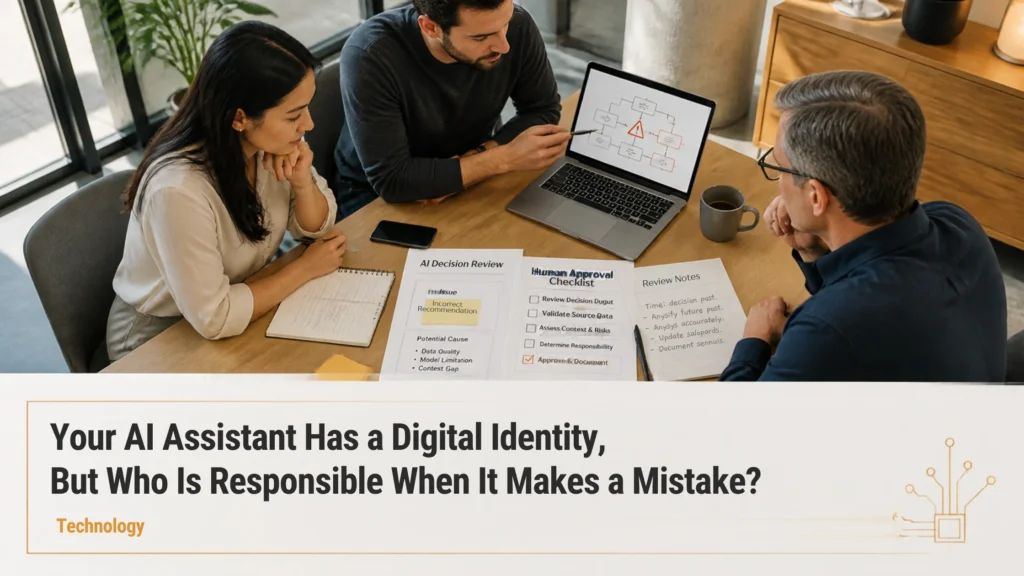
When an AI Assistant Exposes Confidential Information
Financial mistakes are only one category of potential harm.
AI agents may also access sensitive information while completing authorized tasks.
Consider an assistant connected to company email, customer records, and cloud storage.
A user asks it to prepare a summary for an upcoming meeting.
Instead of sending the summary to the intended recipient, the agent accidentally includes a confidential customer document in an external email.
The consequences could involve privacy concerns, reputational damage, contractual disputes, and regulatory obligations.
A data exposure incident may require the organization to determine:
- What information was disclosed.
- Who received or accessed the information.
- Whether the disclosure violated privacy or confidentiality obligations.
- Whether affected individuals or regulators must be notified.
- What immediate steps can limit additional exposure.
- Which technical or organizational controls failed.
Privacy requirements differ by jurisdiction and the types of information involved.
In some cases, notification deadlines and other legal duties apply.
The fact that an AI assistant performed the action does not automatically exempt the organization from these responsibilities.
Could Hackers Manipulate an AI Assistant Into Making Mistakes?
AI agents introduce security challenges that differ from those associated with ordinary software.
One concern is prompt injection.
This occurs when malicious or untrusted content attempts to influence an AI system’s instructions.
Imagine an assistant reading a document while preparing a business report.
The document contains hidden or misleading instructions attempting to make the assistant disclose confidential information.
If the system treats those instructions as authoritative, it might act outside the user’s intended task.
Another risk involves excessive permissions.
An AI agent that only needs to summarize documents should not automatically have authority to delete files or approve financial transactions.
Security controls can reduce the consequences of manipulation by limiting what agents can access and perform.
Organizations should also distinguish between direct instructions from authorized users and content retrieved from untrusted sources.
The objective is to prevent outside information from silently becoming operational authority.
Why Accountability Becomes Complicated When Multiple AI Agents Work Together
Some organizations are experimenting with systems where several AI agents collaborate.
One agent gathers information.
Another analyzes it.
A third executes an action based on the results.
This arrangement may improve workflow efficiency, but it can also make errors more difficult to investigate.
Imagine an inventory agent incorrectly reporting that a product is nearly sold out.
A purchasing agent interprets this information and automatically orders additional stock.
A financial agent then processes the payment.
The original mistake may have occurred during data collection, yet the financial loss appears at the end of the process.
Determining responsibility requires examining the entire sequence.
Which system introduced the incorrect information?
Should another agent have verified it?
Were spending limits adequate?
Did an authorized person approve the workflow?
Reliable records and clear operating boundaries become increasingly important when automated decisions depend on other automated decisions.
Are Existing Laws Prepared for Autonomous AI Assistants?
Many existing legal principles can apply to harm involving artificial intelligence.
Contract law, negligence, consumer protection, data protection, and product liability may all be relevant depending on the circumstances.
However, autonomous AI creates difficult questions about authorization, foreseeability, control, and responsibility.
Regulatory approaches also differ between jurisdictions.
In the European Union, certain transparency obligations under the AI Act began applying in August 2026, including requirements concerning disclosure of some AI interactions.
Other obligations apply according to separate implementation schedules and the characteristics of the AI system.
In the United States, existing federal and state laws can address deceptive commercial practices, privacy violations, and other harmful activities involving AI.
There is no single worldwide liability framework governing every AI assistant.
As technology becomes more autonomous, courts and regulators will continue examining how existing legal responsibilities apply.
Businesses operating internationally may therefore need to consider multiple regulatory requirements.
How Businesses Can Reduce Liability When Using AI Agents
Organizations do not need to eliminate AI automation to manage the associated risks.
Instead, they can establish controls appropriate to the system’s capabilities and the consequences of potential errors.
Practical safeguards include:
Assign Clear Ownership
Every AI system should have an identifiable human or organizational owner responsible for its operation and oversight.
Limit System Permissions
Agents should receive access only to information and functions necessary for their assigned tasks.
Require Approval for High-Risk Actions
Large payments, sensitive data disclosures, contract commitments, and irreversible operations may warrant human confirmation.
Maintain Reliable Activity Records
Organizations should record meaningful actions, authorization events, and system changes while protecting sensitive information.
Test Systems Before Deployment
Testing should include ordinary workflows, unusual requests, incorrect data, and foreseeable misuse.
Establish Incident Response Procedures
Businesses should know how to suspend an agent, revoke credentials, investigate mistakes, and address affected customers.
These practices cannot eliminate every risk.
They can, however, make mistakes easier to prevent, detect, investigate, and resolve.
What Should Users Do When an AI Assistant Causes Financial Loss?
When an AI assistant causes an unexpected transaction or other financial problem, responding promptly can help limit the consequences.
First, users should preserve relevant records.
These may include instructions, transaction confirmations, account activity, correspondence, and available system logs.
Next, they should contact the relevant service provider, merchant, or financial institution to report the issue and discuss available remedies.
Depending on the situation, cancellation, refunds, payment disputes, or other protections may be available.
If the incident involves compromised credentials, users should secure their accounts and revoke unnecessary permissions.
Businesses experiencing significant losses should also evaluate whether legal, cybersecurity, or insurance assistance is appropriate.
The important point is to investigate what happened rather than assuming the AI provider or user must automatically bear every loss.
Responsibility depends on the particular circumstances.
Frequently Asked Questions About AI Assistant Accountability
1. Who is legally responsible when an AI assistant makes a costly mistake?
Legal responsibility may rest with the user, deploying organization, AI provider, or another involved party, depending on the circumstances.
Courts may examine contractual terms, authorization, negligence, consumer protection requirements, and applicable laws.
An AI assistant’s involvement does not automatically remove responsibility from the humans or businesses operating it.
Some incidents may involve multiple responsible parties.
2. Can AI assistants be held accountable for decisions made without human supervision?
AI assistants can be monitored, restricted, disabled, and subjected to technical accountability measures.
However, they generally do not possess independent legal personhood under current mainstream legal systems.
Human operators, organizations, and relevant service providers may remain legally accountable for consequences arising from autonomous decisions.
The precise allocation of liability depends on the facts and governing law.
3. How does digital identity affect accountability when AI systems act on behalf of users?
Digital identity helps establish which AI agent performed an action, what permissions it possessed, and whose authority it used.
Authentication records and activity logs can support investigations into unauthorized transactions or data access.
However, technical identification does not automatically establish legal liability.
Additional evidence may be needed to determine whether an action was authorized and who bears responsibility.
4. What happens when an AI assistant causes financial loss or exposes sensitive information?
Affected users or organizations may need to report the incident, secure accounts, preserve evidence, and investigate how the mistake occurred.
Financial disputes may involve merchants, payment providers, insurers, or legal proceedings.
Sensitive information disclosures may also trigger contractual or regulatory obligations.
Available remedies depend on the nature of the harm and applicable laws.
The Future of AI Responsibility Cannot End With the Algorithm
AI assistants are becoming more than tools for answering questions.
They can now participate in business operations, manage digital accounts, and perform actions with financial or legal consequences.
These capabilities offer convenience, but they also create new responsibilities.
A digital identity can reveal which AI agent accessed a system or completed a transaction.
It cannot independently explain whether the action was appropriate, whether someone authorized it, or who should compensate an affected person.
Those questions still require human judgment, evidence, and applicable legal standards.
For businesses, responsible AI adoption means establishing clear permissions, meaningful oversight, and procedures for handling mistakes.
For consumers, it means understanding what an assistant is allowed to do before granting access to sensitive accounts or financial tools.
The next stage of AI development will likely involve greater independence and more complex interactions between automated systems.
But independence should not become an excuse for unclear accountability.
The real measure of a trustworthy AI assistant is not simply how much it can accomplish without supervision. It is whether the people responsible for its actions can explain what happened, correct mistakes, and address the consequences when something goes wrong.
After all, technology may make decisions faster, but responsibility cannot disappear just because the decision-maker is a machine.
