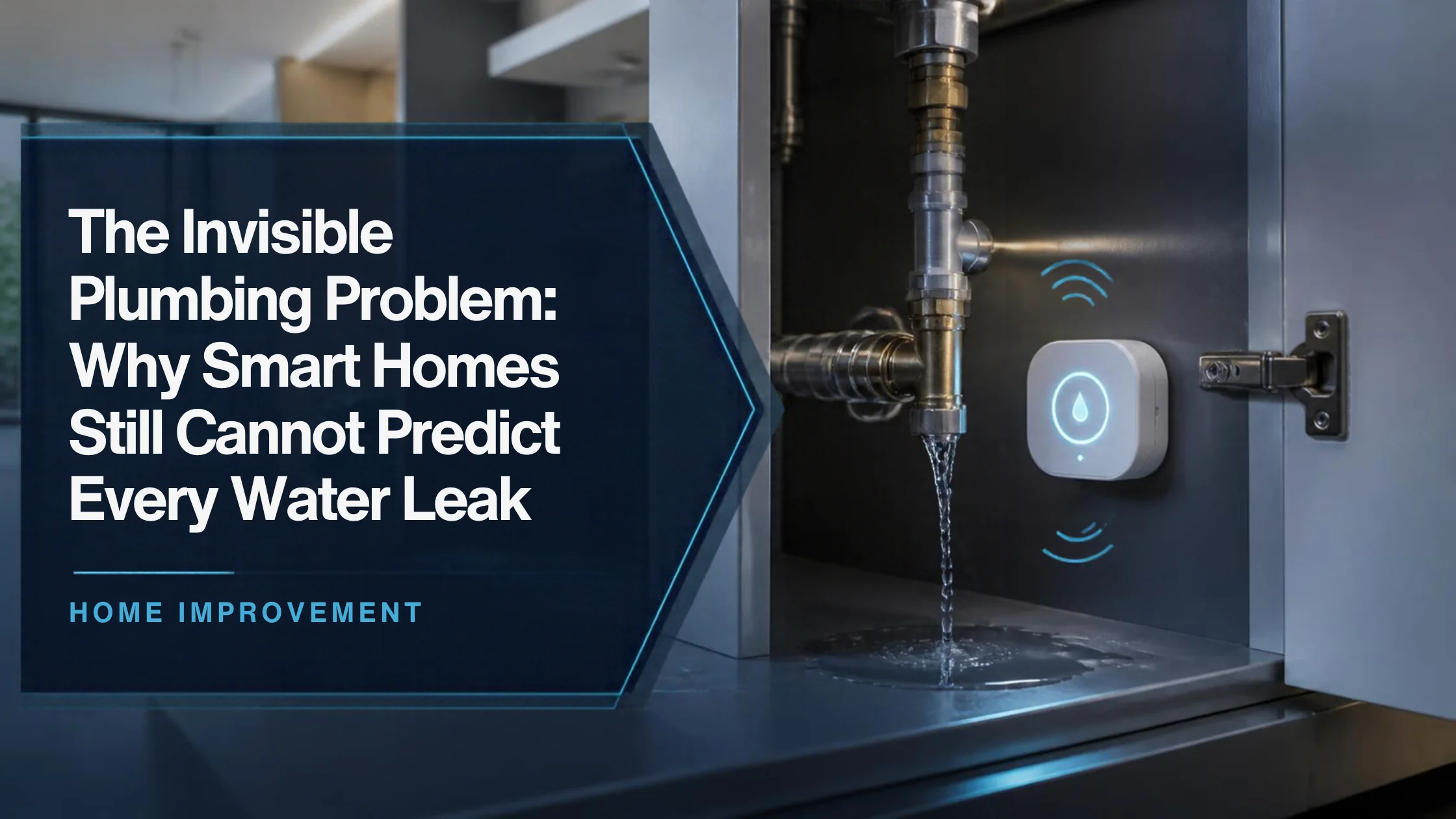
Smart home technology can detect unusual water usage, alert homeowners to moisture, and automatically shut off the water supply when certain problems occur. However, even advanced smart plumbing systems cannot identify every leak, especially when water escapes slowly, remains hidden behind walls, or develops outside monitored areas.
Imagine receiving a notification that your home’s plumbing is functioning normally while a tiny pipe leak quietly damages the kitchen cabinets. The technology reports no problem, yet the damage continues.
Welcome to one of the less glamorous realities of smart home technology: Even a house filled with sensors can have plumbing problems nobody sees coming.
The Smart Home Promise: Can Technology Really Prevent Every Leak?
Modern homes are becoming increasingly connected.
Smart thermostats manage temperatures, security cameras monitor entrances, and automated lighting systems adjust to daily routines.
Plumbing technology has joined this transformation.
Today’s smart water monitoring systems can track consumption, identify unusual patterns, and send alerts directly to smartphones.
Some advanced devices can even shut off a home’s water supply automatically when they detect a potentially serious leak.
These capabilities offer meaningful protection against certain types of water damage.
However, smart plumbing systems are not designed to detect every possible failure.
A sensor installed beneath the kitchen sink cannot identify moisture behind an upstairs bathroom wall.
Likewise, a flow-monitoring device may struggle to distinguish a tiny hidden leak from normal household water consumption.
The technology is valuable, but its effectiveness depends on what it measures, where it is installed, and how the plumbing problem develops.
Understanding these limitations helps homeowners make better decisions about protecting their properties.
How Do Smart Water Leak Detection Systems Work?
Before examining what smart plumbing technology misses, it helps to understand how different devices identify potential problems.
Not all smart leak detectors operate the same way.
Point-of-Leak Moisture Sensors
These compact devices are commonly placed near washing machines, water heaters, toilets, sinks, and other locations where leaks may develop.
They detect water when moisture reaches their sensing contacts.
For example, a sensor placed beneath a washing machine might send an alert when water begins collecting on the floor.
However, these devices generally cannot identify water escaping somewhere beyond their immediate detection area.
A leak inside the wall behind the washing machine might continue without triggering the sensor.
Whole-Home Water Flow Monitors
Flow-monitoring systems measure water moving through a particular supply line.
Some devices analyze usage patterns to identify unusual consumption or water flow continuing when fixtures should be off.
They may detect a running toilet, burst supply pipe, or persistent leak.
However, their performance depends on factors such as installation location, detection thresholds, plumbing configuration, and household usage patterns.
Automatic Water Shutoff Systems
Certain monitoring systems connect to valves capable of stopping water flow when a potential leak is detected.
This can reduce the amount of water released during specific plumbing failures.
However, shutting off the incoming supply does not eliminate every possible source of water damage.
Water already inside pipes, storage tanks, or appliances may still escape.
The important point is that detection and prevention are not the same thing.
Why Smart Water Leak Detectors Miss Certain Plumbing Problems
Smart technology relies on measurable signals.
A moisture detector needs water to reach its sensing surface. A flow monitor needs a detectable change in water movement. Other systems may analyze pressure changes or acoustic signals.
When a leak does not produce a recognizable signal, the technology may not identify it.
Several factors explain why this happens.
Small Leaks Can Fall Below Detection Thresholds
A tiny leak may release water so slowly that the change in flow is difficult to distinguish from normal activity.
Imagine a pipe connection releasing a few drops every minute.
The amount may seem insignificant, especially compared with showers, laundry, and dishwashing.
Yet persistent moisture can gradually affect surrounding materials.
Not every monitoring system has the sensitivity needed to identify such a small problem consistently.
Water May Never Reach the Sensor
Moisture detectors are effective only when water enters their detection area.
A leak might travel along framing, insulation, or the underside of a cabinet before collecting somewhere else.
The water could cause damage long before it reaches a sensor.
Normal Water Usage Can Complicate Detection
A busy household uses water at unpredictable times.
Someone might take a late shower, run the dishwasher overnight, or water the garden early in the morning.
Monitoring systems must distinguish ordinary activity from potentially abnormal consumption.
An algorithm may require stronger evidence before reporting a leak to avoid excessive false alarms.
This creates a tradeoff between sensitivity and unnecessary notifications.
Can Hidden Pipe Leaks Develop Without Triggering Smart Sensors?
Yes. Hidden pipe leaks can develop without triggering smart sensors, particularly when the escaping water does not contact a moisture detector or create a recognizable flow pattern.
Many residential plumbing lines run through walls, ceilings, crawl spaces, and beneath floors.
These concealed locations create challenges for both homeowners and monitoring technology.
For example, a slow leak inside a bathroom wall may dampen insulation before becoming visible.
A sensor placed beneath the bathroom sink would not necessarily detect moisture developing several feet away.
Similarly, a small leak beneath a concrete slab could allow water to collect in surrounding soil or building materials.
A whole-home flow monitor might identify some underground supply leaks, but detection is not guaranteed.
Some leaks develop gradually, while others occur only under particular conditions.
This is why homeowners should never assume that the absence of a warning means every pipe is functioning properly.
Which Household Plumbing Leaks Are Hardest for Smart Technology to Detect?
Certain plumbing problems are particularly challenging because they occur in concealed locations or produce inconsistent warning signs.
1. Slow Leaks Behind Walls
Small leaks around pipe joints can gradually saturate drywall, insulation, and wooden framing.
Because the water remains hidden, homeowners may not notice the problem until staining, odors, or material deterioration appear.
A nearby moisture detector may never encounter the escaping water.
2. Leaks Beneath Concrete Slabs
Some homes have water supply lines running beneath their foundations.
Leaks in these pipes may release water into the soil or surrounding construction materials.
Depending on their size and location, they can be difficult to detect through ordinary observation.
Flow-monitoring systems may identify abnormal usage, but determining the actual leak location usually requires additional investigation.
3. Intermittent Appliance Leaks
Washing machines and dishwashers do not operate continuously.
A loose connection or failing seal may release water only during certain cycles.
If the water drains away, evaporates, or collects outside the sensor’s location, the device might miss the event.
These problems can be especially confusing because the surrounding area may appear dry during inspection.
4. Drain and Wastewater Leaks
Many whole-home water monitors focus on the pressurized supply system.
However, drainpipes carry wastewater away from fixtures.
A cracked drainpipe may leak only when someone showers, empties a bathtub, or runs the washing machine.
Because the issue occurs after the water has already passed through the supply system, a flow monitor may not recognize the problem as a leak.
5. Exterior and Underground Plumbing Leaks
Outdoor water lines, irrigation connections, and underground pipes may fall outside certain monitoring arrangements.
A device installed after a particular branch connection cannot measure water flowing through that unmonitored section.
This makes installation design just as important as the technology itself.

Why Small Leaks Can Become Expensive Problems
Large pipe bursts attract immediate attention.
Water spreads across the floor, alarms sound, and the need for action becomes obvious.
Small leaks are more deceptive.
A tiny amount of moisture escaping repeatedly can affect building materials over time.
Drywall may soften, wooden components may swell, and flooring adhesives may deteriorate.
Persistent dampness can also create conditions that support microbial growth.
The actual damage depends on how much water escapes, where it travels, the materials involved, and how quickly the problem is addressed.
A slow leak behind a cabinet might remain unnoticed until the cabinet begins warping.
Likewise, recurring moisture beneath flooring may not become apparent until discoloration or movement develops.
This explains why early detection matters even when the amount of escaping water seems minor.
A leak does not need to create a dramatic flood to become a significant repair concern.
How Reliable Are Smart Plumbing Systems at Preventing Water Damage?
Smart plumbing systems can reduce water damage risk, but their reliability varies considerably.
Their effectiveness depends on the equipment, installation quality, maintenance, and characteristics of the leak.
Automatic shutoff systems can be especially useful when a monitored supply pipe experiences a sudden major failure.
Stopping the incoming water may limit the amount released.
However, several limitations remain:
- Power interruptions: Some systems depend on electricity or functioning backup power.
- Connectivity problems: Internet or wireless failures can interfere with remote alerts, depending on the device.
- Sensor placement: Water must reach a point detector before it can respond.
- Detection settings: Thresholds may affect which unusual water patterns generate alerts.
- Plumbing coverage: Monitoring may exclude certain branches or systems.
- Mechanical limitations: A shutoff valve must operate correctly to stop the intended water supply.
A device may detect a problem without being able to stop it automatically.
Likewise, a working shutoff valve may not prevent damage from drain leaks, roof leaks, or water already stored inside an appliance.
Reliable protection requires understanding exactly what the equipment can and cannot do.
The False Sense of Security in a Fully Connected Home
One of the biggest risks associated with smart technology is assuming that monitoring eliminates the need for ordinary maintenance.
A homeowner might believe that an expensive detection system will identify any plumbing problem before damage occurs.
As a result, minor warning signs may receive less attention.
A faint musty smell near a cabinet could be dismissed because the app reports normal conditions.
A slightly higher water bill might seem unimportant because no leak alert has appeared.
However, a normal device reading only indicates that the system has not detected a problem according to its monitoring capabilities.
It does not prove that every plumbing component is free from defects.
This distinction applies to many forms of home technology.
Security cameras cannot observe every corner of a property, and smoke detectors cannot prevent every fire.
Similarly, smart water monitoring is an additional protective measure rather than a substitute for maintaining the plumbing system.
Plumbing Warning Signs That Technology Might Miss
Homeowners can still identify possible plumbing issues through ordinary observation.
Changes in the home’s appearance, smell, or water performance may provide useful clues.
Potential warning signs include:
- Unexplained increases in water bills.
- Persistent damp or musty odors.
- Discoloration on walls or ceilings.
- Peeling paint or bubbling wall surfaces.
- Warped flooring or swollen cabinets.
- Repeatedly damp areas near plumbing fixtures.
- Unusual sounds of running water when fixtures are turned off.
- Unexpected reductions in water pressure.
- Recurring moisture around toilets, showers, or appliances.
These symptoms do not automatically confirm a hidden plumbing leak.
For example, staining may result from condensation or exterior water intrusion.
Nevertheless, recurring or unexplained changes deserve attention.
A professional evaluation can help identify the actual source rather than relying on assumptions.
Can Predictive Artificial Intelligence Solve Hidden Plumbing Problems?
Artificial intelligence may improve how smart plumbing systems interpret water usage.
Instead of reacting only to fixed thresholds, advanced monitoring algorithms can examine recurring patterns and identify behavior that differs from established household routines.
For example, a system might recognize that water usually stops flowing overnight.
If continuous flow begins appearing during those hours, it could flag the change for investigation.
Other monitoring approaches may combine flow measurements, pressure information, or acoustic signals.
However, prediction remains limited by the information available.
An algorithm cannot reliably identify a problem that produces no measurable evidence within its monitoring system.
It may also confuse ordinary changes in household activity with unusual plumbing behavior.
More sophisticated technology can improve detection in some circumstances, but it does not make plumbing failures entirely predictable.
How Homeowners Can Use Smart Leak Detection More Effectively
The most practical approach combines technology with regular observation and appropriate plumbing maintenance.
Homeowners do not need to abandon smart systems simply because the devices have limitations.
Instead, they should use them strategically.
Understand the Monitoring Area
Determine which plumbing lines and fixtures are covered.
Ask whether the system monitors exterior plumbing, irrigation lines, or specific appliance connections.
Understanding coverage makes it easier to recognize potential blind spots.
Place Moisture Sensors Thoughtfully
Common locations include areas beneath sinks, near water heaters, behind toilets, and around washing machines.
Sensor placement should follow manufacturer instructions and account for where escaping water is likely to collect.
Maintain the Equipment
Check device batteries, connectivity, and operational status according to the manufacturer’s recommendations.
Where testing is supported, confirm that alerts and automatic shutoff functions work as intended.
Continue Basic Plumbing Inspections
Look for visible corrosion, dripping connections, staining, and unexpected moisture.
Pay attention to changes in water bills and household water pressure.
Investigate Recurring Problems
A repeated alert should not automatically be dismissed as a software error.
Likewise, unexplained water damage deserves investigation even when the monitoring system reports normal conditions.
These habits make smart technology part of a broader home maintenance strategy rather than the entire strategy.
When Professional Leak Detection Becomes Necessary
Smart water monitors can help identify unusual conditions, but they rarely provide a complete diagnosis of every plumbing issue.
Professional plumbers may use additional equipment and investigative methods to locate concealed leaks.
Depending on the situation, these may include acoustic listening devices, pressure testing, moisture meters, thermal imaging, or other specialized techniques.
Each method has limitations, and no single tool works for every type of leak.
For example, thermal imaging identifies temperature differences rather than directly seeing water inside a wall.
Moisture readings can help narrow down affected areas, but determining the source may require further inspection.
A professional can assess the plumbing configuration, review symptoms, and select appropriate diagnostic methods.
Prompt evaluation becomes particularly important when moisture continues spreading, water pressure changes significantly, or visible damage begins affecting building materials.
Frequently Asked Questions About Smart Plumbing and Hidden Leaks
1. Why do smart water leak detectors fail to identify certain plumbing problems?
Smart water leak detectors may miss problems because their sensors cover limited areas or rely on measurable changes in water flow, pressure, or moisture.
Small leaks may fall below detection thresholds, while concealed water may never reach a moisture sensor.
Device placement, installation configuration, and monitoring limitations also affect performance.
2. Can hidden pipe leaks develop without triggering smart home sensors?
Yes. Hidden leaks can develop inside walls, ceilings, underground pipes, or beneath concrete slabs without triggering an alert.
This happens when the escaping water remains outside the monitored area or does not produce a detectable change.
A normal reading should not replace investigation when physical warning signs appear.
3. How reliable are smart plumbing systems at preventing water damage?
Smart plumbing systems can help reduce damage from certain leaks, particularly when they detect unusual water flow and activate automatic shutoff valves.
However, they cannot guarantee complete prevention.
Their effectiveness depends on the equipment, maintenance, sensor coverage, and type of plumbing failure.
4. What types of household plumbing leaks are hardest for smart technology to detect?
Slow leaks behind walls, underground pipe leaks, intermittent appliance leaks, and wastewater drain leaks can be especially challenging.
These problems may occur outside monitored areas or produce signals that are difficult to distinguish from normal water usage.
Professional assessment may be necessary to locate and address them.
A Smarter Home Still Needs Human Attention
Smart plumbing technology has changed how homeowners identify and respond to water problems.
Automatic alerts, consumption monitoring, and shutoff systems can provide valuable protection against certain plumbing failures.
However, sophisticated technology cannot eliminate every blind spot.
Some leaks develop too slowly, occur too far from sensors, or produce signals that monitoring systems cannot reliably interpret.
That makes routine observation and maintenance just as important as digital monitoring.
A connected home should not encourage homeowners to ignore unusual odors, unexpected water bills, or signs of moisture.
Instead, technology should help them respond more effectively when something changes.
The most sensible approach is to combine smart detection with responsible plumbing care and professional evaluation when needed.
After all, a home does not become completely protected simply because its plumbing can send notifications.
The smartest home is not the one with the most sensors. It is the one where technology and human attention work together to catch problems before they become bigger repairs.
