For centuries, architecture has been associated with permanence. Buildings are designed to withstand decades of weather, support generations of occupants, and remain standing long after their original creators are gone.
But what if designing buildings to last forever is not always the most sustainable approach?
Cities constantly change. Businesses expand, neighborhoods evolve, and communities develop new needs. Yet buildings often remain fixed, even when their original purpose disappears.
An office building may become vacant after businesses relocate. A shopping center might lose relevance as consumer habits change. Temporary facilities may be needed for only a few years, but constructing them using conventional methods can require significant resources.
These situations are encouraging architects and researchers to explore a different possibility: buildings designed with an intentional end to their original use.
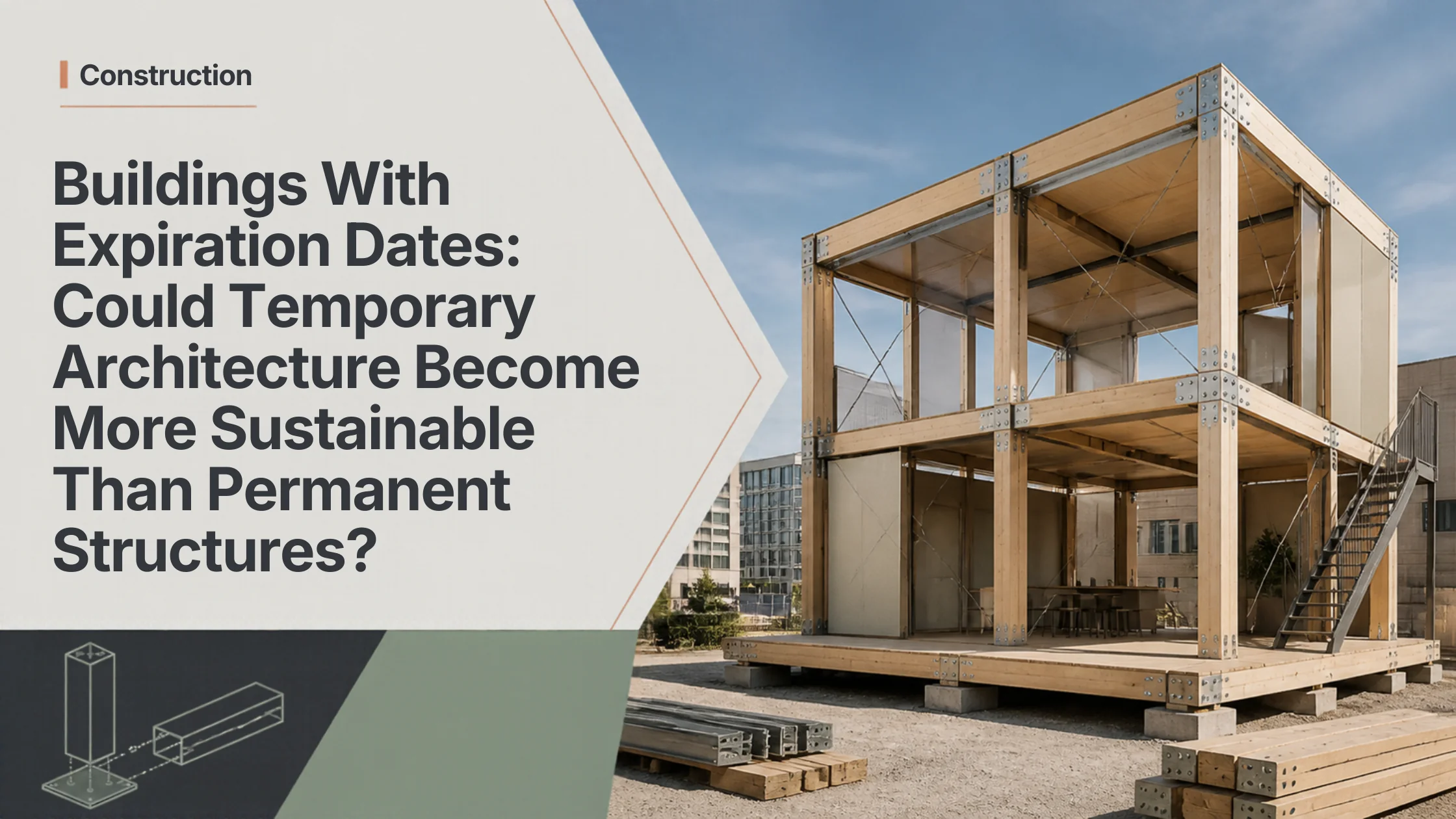
Instead of becoming permanent fixtures, some structures could be dismantled, relocated, reconfigured, or reused when they are no longer needed.
This approach raises an interesting question: Could buildings with planned expiration dates become more environmentally responsible than structures designed to remain in place indefinitely?
The answer depends on much more than construction speed or building lifespan. Material reuse, energy efficiency, transportation, environmental impact, and future adaptability all influence whether temporary architecture can genuinely support sustainability.
What Does It Mean for a Building to Have an Expiration Date?
A building with an expiration date is not necessarily a structure designed to deteriorate after a predetermined period.
Instead, the concept refers to architecture created around an expected duration of use, with plans for what happens afterward.
A temporary building might serve a community for five years before being relocated. Another structure could support a major event for several weeks and then be dismantled for reuse elsewhere.
The critical difference involves planning for the building’s next stage.
Traditional construction frequently focuses on creating a permanent structure for a specific location.
Temporary architecture may prioritize flexibility, relocation, and material recovery.
However, temporary does not automatically mean sustainable.
A disposable building constructed for a short event may generate substantial waste, while a durable building used for generations can distribute its initial environmental impact across many years.
The sustainability question is therefore not simply how long a structure stands, but how efficiently its materials and resources are used throughout their entire lifecycle.
Why Permanent Buildings Are Facing New Sustainability Questions
Permanent architecture provides stability, security, and long-term economic value.
However, constructing buildings requires significant quantities of materials, energy, and transportation.
Concrete, steel, glass, insulation, and finishing products all contribute to the environmental footprint of a project.
According to the United Nations Environment Programme’s 2025–2026 Global Status Report for Buildings and Construction, the sector accounts for approximately 37% of global carbon dioxide emissions and nearly half of global material extraction.
These figures highlight why improving construction practices is important.
Environmental impacts also continue after construction.
Buildings require electricity, heating, cooling, maintenance, repairs, and eventual renovation.
When a structure becomes unsuitable for its intended purpose, demolition can generate additional waste.
This creates an opportunity to reconsider how buildings are designed, maintained, adapted, and eventually taken apart.
However, extending the useful life of an existing building often remains preferable to replacing it unnecessarily.
Could Temporary Buildings Actually Produce Less Construction Waste?
Temporary architecture has the potential to reduce construction waste when its components are designed for repeated use.
Traditional demolition can damage materials, making them difficult to recover in usable condition.
Concrete may be crushed, steel may be recycled, and other components may be discarded.
While recycling is valuable, it can still require significant processing and energy.
Temporary buildings designed for disassembly offer another possibility.
Structural frames, wall panels, flooring systems, and roofing components could be carefully removed and installed in another location.
Instead of treating an entire building as waste, its parts become resources for future construction.
Research published in the Journal of Building Engineering in 2024 found that reusing temporary membrane structures could reduce their global warming potential per square meter of covered area across their service lives.
However, the study also identified transportation as an important contributor to emissions.
The environmental advantage depends on successful reuse, not simply the ability to dismantle a structure.
How Modular Construction Could Make Buildings Reusable
Modular construction is one of the most practical approaches to temporary architecture.
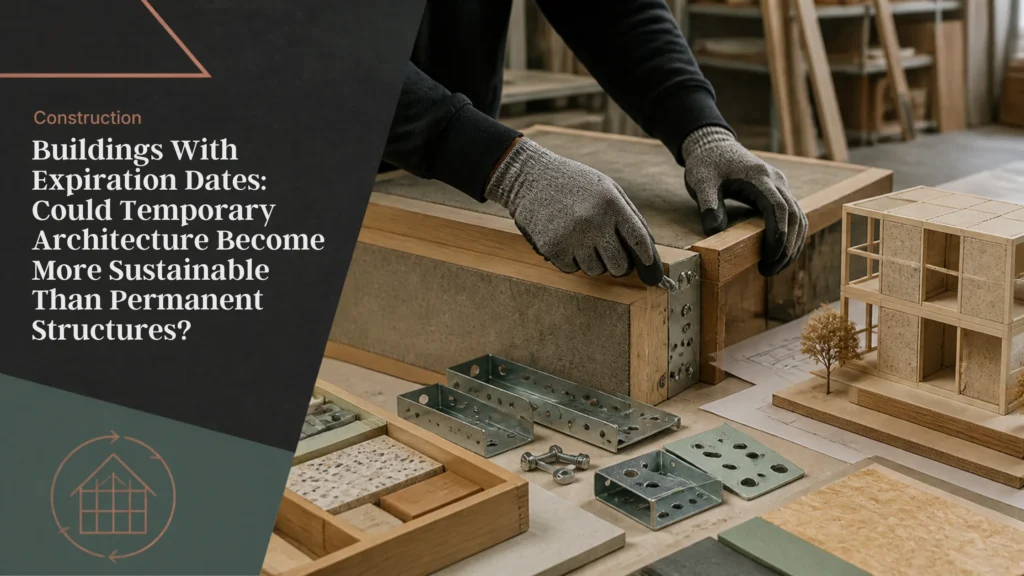
Instead of constructing every component directly at a building site, manufacturers produce standardized sections that can be transported and assembled.
These sections may contain structural framing, walls, windows, insulation, and utility connections.
Modular construction can offer several potential advantages:
- Reduced material waste: Controlled manufacturing may improve material planning and cutting accuracy.
- Faster installation: Prefabricated sections can reduce certain on-site construction activities.
- Flexible layouts: Compatible modules may allow buildings to expand or change configuration.
- Component recovery: Buildings designed for disassembly can potentially support relocation and reuse.
- More predictable manufacturing: Repeated production processes can support quality control.
However, modular buildings are not automatically temporary or reusable.
Many are designed for permanent installation.
To achieve genuine circularity, designers must consider how components will be separated, transported, inspected, and reused before construction begins.
What Happens When a Temporary Building Reaches Its End?
A building’s expiration date could mark the beginning of its next use rather than the end of its physical existence.
Imagine a modular school built to accommodate a temporary increase in student enrollment.
After several years, the surrounding population changes, and the additional classrooms are no longer required.
Instead of demolishing the building, the modules could potentially be moved to another community experiencing increased demand.
The structure’s original purpose ends, but its materials continue providing value.
This concept supports the circular economy, which seeks to keep products and materials in use while reducing waste.
The European Commission’s Joint Research Centre has explored design for deconstruction and modular construction as methods for recovering building components.
However, successful relocation requires careful engineering, appropriate building approvals, and confirmation that reused components remain suitable for their next application.
Could Temporary Architecture Reduce Embodied Carbon?
Embodied carbon refers to greenhouse gas emissions associated with producing, transporting, installing, maintaining, replacing, and disposing of building materials.
Manufacturing energy-intensive materials such as cement and steel can contribute significantly to these emissions.
Temporary structures may reduce embodied carbon when reused components replace the need for newly manufactured materials.
For example, a structural frame used across several projects may distribute its initial manufacturing impacts over multiple applications.
However, frequent transportation, replacement parts, and repeated assembly can reduce these savings.
A 2026 study examining prefabricated buildings found that improved circularity did not always produce lower environmental impacts across every measure.
This demonstrates why sustainable architecture requires detailed assessment rather than broad assumptions.
A reusable building may offer environmental advantages under suitable conditions, but its performance must be evaluated across the entire lifecycle.
Why Building Lifespan Alone Cannot Determine Sustainability
A building designed to last ten years is not necessarily greener than one expected to remain useful for a century.
The comparison must consider the services each structure provides.
A permanent building that operates efficiently for decades may spread its initial construction impacts across a long period.
A temporary building repeatedly assembled and transported may accumulate substantial emissions.
Environmental researchers often use lifecycle assessment to evaluate these differences.
This process considers material production, transportation, construction, operation, maintenance, and end-of-life activities.
For a fair comparison, buildings must provide comparable functions, usable space, safety, and comfort over an equivalent period.
The central question becomes whether one approach provides the required service with fewer overall environmental impacts.
Sustainability depends on lifetime performance, not simply whether a building is classified as temporary or permanent.
Could Temporary Buildings Become More Energy Efficient?
Temporary architecture is often associated with lightweight materials and rapid installation.
However, these characteristics do not guarantee energy efficiency.
Poor insulation, uncontrolled air leakage, and inefficient cooling systems can increase operational energy consumption.
In climates requiring substantial heating or air conditioning, these weaknesses can become particularly important.
A temporary building used for several years may consume more operational energy than a well-designed permanent structure.
Modern modular construction can incorporate high-performance insulation, efficient ventilation, and appropriately designed heating and cooling systems.
The challenge is balancing energy performance with portability and ease of disassembly.
Components should remain durable enough for repeated use without creating unnecessary material demands.
Where Could Temporary Architecture Make the Most Sense?
Temporary architecture is particularly useful when the need for a building is expected to change.
Examples include temporary classrooms, construction offices, exhibition spaces, pop-up retail locations, and facilities supporting short-term community projects.
A growing neighborhood might require additional educational space before a permanent school expansion becomes financially practical.
A business could use a relocatable office while its long-term facility is under construction.
Event organizers might reuse the same structural components across multiple locations rather than constructing disposable venues.
In these situations, flexibility can prevent resources from becoming locked into facilities that are no longer needed.
However, temporary construction should not become an excuse for poor planning or low-quality facilities.
Buildings must still provide suitable conditions for their intended users.
Could Temporary Housing Help Communities Respond to Change?
Temporary housing can provide accommodation following disasters, during construction projects, or when communities experience sudden population changes.
Modular units may be deployed more quickly than conventional housing under certain circumstances.
However, temporary housing presents significant social and practical challenges.
Residents need reliable utilities, weather protection, sanitation, accessibility, and appropriate living conditions.
Poorly designed temporary accommodation can become uncomfortable, expensive to operate, or difficult to maintain.
There is also a risk that temporary housing remains occupied far longer than originally planned.
A sustainable approach must therefore consider residents’ needs alongside environmental performance.
Relocatable housing can be valuable, but it should not replace long-term investment in safe, affordable, and stable homes.
Could Buildings Be Designed for Multiple Future Purposes?
One of the most promising ideas involves designing buildings that can change functions over time.
A structure might initially serve as office space before becoming classrooms or a community facility.
Instead of demolishing the building, owners could reconfigure interior areas and replace selected components.
This approach is known as adaptable architecture.
It differs from temporary construction because the building may remain in the same location throughout its life.
However, both approaches share the principle of avoiding unnecessary demolition.
The international standard ISO 20887 provides guidance on designing buildings for disassembly and adaptability.
Its principles encourage consideration of how building components can be changed, separated, and reused.
In some situations, a permanent adaptable building may offer greater sustainability benefits than relocating a temporary one.
What Role Could Material Passports Play?
A major challenge in reusing building materials is knowing what those materials are and whether they remain suitable.
Material passports offer a possible solution.
These digital records can contain information about building components, including material composition, dimensions, manufacturing details, and previous uses.
When a structure reaches the end of its original purpose, the information could help determine which parts can be recovered.
For example, a reusable steel frame might have documentation describing its specifications and installation history.
This could make future reuse planning more practical.
However, documentation alone does not establish that a component is safe for another application.
Structural assessments, condition checks, and compliance with relevant standards remain necessary.
Material passports could support circular construction by making reusable resources easier to identify and manage.
Could Temporary Buildings Become Financially Attractive?
Temporary architecture may reduce certain upfront expenses when construction processes are standardized and installation times are shorter.
However, total costs depend on project requirements.
Manufacturing, transportation, foundations, utility connections, permitting, maintenance, and dismantling all contribute to overall expenses.
A relocatable building may provide financial value when it can serve several projects over time.
For example, an organization operating temporary facilities across different locations might reuse modules instead of purchasing new buildings for every project.
However, repeated transport and storage can become expensive.
Temporary architecture may also face financing and insurance challenges when structures are intended to move between sites.
Economic sustainability requires realistic planning for the full service life, not just the initial construction budget.
Are Temporary Buildings Subject to Safety Regulations?
Temporary structures must still meet applicable safety requirements.
Depending on location and intended use, regulations may address structural stability, fire protection, accessibility, electrical installations, sanitation, and occupancy.
A temporary building should not be considered exempt from essential safety standards merely because it will eventually be removed.
Regulatory requirements vary between jurisdictions.
Some places establish specific permit categories based on the intended duration or type of temporary structure.
In Singapore, for example, certain temporary buildings require professional engineering oversight and a permit to use.
Other jurisdictions apply different approval processes.
Building owners and project teams must verify local requirements before installation, occupancy, relocation, or reuse.
Could Climate Change Make Relocatable Buildings More Useful?
Increasing exposure to certain environmental hazards may encourage communities to reconsider where facilities are located.
Relocatable buildings could potentially support temporary operations while damaged infrastructure is repaired or while longer-term plans are developed.
For example, modular facilities might provide temporary workspaces or educational buildings following severe weather.
However, mobility does not automatically make a building climate-resilient.
Structures must still withstand the environmental conditions of their intended location.
Repeated relocation can also involve significant costs and logistical challenges.
In many situations, strengthening existing buildings and improving long-term planning may be more appropriate.
Temporary architecture is one possible resilience strategy rather than a universal response to changing climate risks.
Could Permanent and Temporary Architecture Eventually Merge?
The future of construction may involve fewer rigid distinctions between permanent and temporary buildings.
Instead of designing structures either to remain fixed indefinitely or to be discarded after short use, architects could combine durability with adaptability.
A building might have a long-lasting structural framework while its interior systems and functional spaces change regularly.
Other structures could be designed for complete disassembly and relocation.
This approach allows the expected duration of use to influence design without sacrificing safety or quality.
The Ellen MacArthur Foundation has identified adaptable and relocatable buildings as potential circular business models for real estate.
The broader objective is to preserve material value and reduce unnecessary construction.
Rather than giving every building an expiration date, future architecture may give buildings more options for what happens next.
People Also Ask About Temporary Architecture and Sustainable Buildings
1. Are Temporary Buildings More Environmentally Friendly Than Permanent Buildings?
Temporary buildings can be environmentally beneficial when they use reusable components, minimize construction waste, and provide suitable energy performance. However, temporary construction is not automatically greener. Repeated transportation, inefficient insulation, and short single-use lifespans can increase environmental impacts. A lifecycle assessment is necessary to compare temporary and permanent structures fairly.
2. Can Temporary Buildings Be Dismantled and Reused Somewhere Else?
Yes. Certain modular and demountable structures are designed to be taken apart, transported, and reassembled at another location. Reuse depends on the building’s structural design, connection systems, component condition, and applicable regulations. Buildings constructed without disassembly in mind may be difficult or expensive to relocate. Reused components must also meet relevant safety requirements.
3. How Long Can Temporary Buildings Last Before They Need Replacement?
The lifespan of a temporary building depends on its materials, design, maintenance, environmental exposure, and intended use. Some structures serve short events, while others remain functional for several years or longer. A temporary designation does not necessarily mean the building materials have a short service life. Legal occupancy limits may also differ from the structure’s physical durability.
4. Could Reusable Buildings Reduce Construction Costs and Carbon Emissions?
Reusable buildings may reduce material demand and associated emissions when components are successfully used across multiple projects. They may also lower certain construction expenses by reducing repeated manufacturing and installation work. However, transport, storage, refurbishment, and maintenance costs must be considered. Environmental and financial benefits depend on actual reuse rates and the complete lifecycle of the structure.
The Future of Sustainable Architecture May Be Designed for Change
Architecture has traditionally celebrated buildings that endure.
Long-lasting structures can provide cultural value, community stability, and environmental benefits when they remain useful across generations.
However, permanence is not always the best response to changing human needs.
Some facilities are required for only a limited period, while others become outdated long before their structural materials reach the end of their useful lives.
Temporary architecture offers another possibility.
By designing buildings for reuse, relocation, and disassembly, architects may be able to reduce waste and preserve valuable materials.
Yet successful sustainability requires careful consideration of energy performance, transportation, durability, affordability, and safety.
The most sustainable building is not necessarily the one that stands the longest or disappears the fastest. It is the one that provides lasting value while using resources responsibly throughout its entire lifecycle.
Future architecture may therefore focus less on whether a structure is permanent or temporary and more on whether it can adapt as circumstances change.
A building might eventually leave its original site without becoming waste.
Its walls could serve another community, its structural frame could support a new facility, and its materials could remain useful long after its first purpose ends.
Buildings with expiration dates may not replace permanent architecture, but they could help introduce a construction philosophy where the end of one building’s use becomes the beginning of another.
