A refrigerator begins using more electricity than usual. A washing machine develops an unusual vibration. An air conditioning system starts operating less efficiently, while a dishwasher detects a potential problem with its water circulation.
Traditionally, homeowners would discover these problems through strange noises, declining performance, or complete equipment failure. They would then decide which issue needed immediate attention and which could wait.
But artificial intelligence could change that process.
Instead of simply reporting problems, future connected appliances might evaluate their own condition, communicate with other household systems, compare repair costs, and recommend which maintenance tasks deserve priority.
A refrigerator might warn that its cooling performance requires attention before a minor washing machine vibration becomes a concern. An intelligent home management system could consider safety, household routines, repair budgets, and estimated equipment lifespan before suggesting a maintenance schedule.
This raises an interesting question: Could AI eventually become the household decision-maker that determines which appliances deserve repairs first?
The idea introduces possibilities for preventive maintenance, cost management, and more efficient homes. However, it also creates concerns about automated decision-making, inaccurate diagnoses, privacy, and the possibility of technology influencing household spending.
As artificial intelligence becomes increasingly connected to physical environments, home maintenance may evolve from reacting to broken equipment into managing competing repair priorities.
What Happens When Home Appliances Become Intelligent Decision-Makers?
Smart appliances are already capable of collecting operational information, reporting error codes, and connecting to mobile applications.
Some can monitor energy consumption, track operating cycles, and notify homeowners when maintenance may be necessary.
However, most current systems remain limited to predefined functions and manufacturer-supported diagnostics.
The next stage could involve AI-powered appliance maintenance, where connected devices use sensor readings, historical performance, and predictive models to estimate equipment conditions.
Instead of issuing a simple error notification, an intelligent system might evaluate several possibilities.
It could estimate whether a problem is likely to worsen, determine whether immediate professional inspection is appropriate, and compare potential repair costs with other household expenses.
A more advanced system might coordinate these recommendations across multiple appliances.
The difference is significant.
Traditional connected devices primarily report information. Future AI systems could help interpret that information and recommend decisions.
However, recommending a repair does not mean that AI can reliably diagnose every mechanical problem or should independently authorize expensive work.
How Could Appliances Detect Problems Before They Break?
Predictive maintenance is one of the technologies making intelligent appliance management increasingly realistic.
The approach involves analyzing equipment performance to identify unusual patterns that may indicate developing problems.
An appliance could use several measurements to monitor its condition:
- Electrical consumption: Unusual changes in power usage may indicate inefficient operation or certain equipment problems.
- Vibration patterns: Changes in vibration can sometimes suggest mechanical wear or imbalance.
- Temperature readings: Unexpected fluctuations may indicate cooling or heating performance concerns.
- Water flow measurements: Irregular consumption may help identify selected plumbing or appliance issues.
- Operating cycles: Changes in cycle duration or frequency may reveal performance differences.
Research published in 2025 explored manufacturer-independent monitoring of washing machines using vibration, electrical current, and water consumption measurements.
The work demonstrated the potential for improved remote diagnosis while also identifying challenges involving sensor accuracy, connectivity, and implementation costs.
A 2026 study further investigated AI-based systems that detect appliance anomalies and recommend corrective actions using power consumption information.
These developments suggest that intelligent maintenance may become increasingly practical.
Still, detecting abnormal behavior is not the same as identifying its exact cause.
A refrigerator using more electricity could be responding to warm room temperatures, frequent door openings, or a mechanical problem.
Professional evaluation may still be necessary.
Could Appliances Negotiate Which Repairs Come First?
The concept of appliances negotiating repairs does not require machines to develop opinions or personal desires.
Instead, negotiation could involve different systems exchanging information and comparing priorities.
Consider a household where three appliances report potential problems simultaneously.
The refrigerator identifies unstable cooling temperatures. The washing machine detects increased vibration. The dishwasher reports that a routine maintenance indicator has been triggered.
An intelligent home maintenance system could evaluate each condition according to predefined criteria.
The refrigerator might receive higher priority because poor cooling could compromise food storage.
The washing machine might receive a recommendation for inspection depending on the severity of the vibration.
The dishwasher’s routine maintenance reminder could remain lower priority.
These recommendations would represent computational prioritization rather than conscious negotiation.
In a future system, multiple devices might submit requests to a central household assistant, which would evaluate available information and suggest an order of action.
The important question is whether those recommendations accurately reflect real-world urgency.
Why Safety Must Come Before Repair Costs
An AI system designed to manage household repairs should prioritize safety over convenience or financial savings.
Some equipment problems are merely inconvenient.
Others can create immediate risks involving electricity, fire, gas, water damage, or unsafe food temperatures.
A small cosmetic defect on an appliance is different from a suspected electrical fault.
Similarly, unusual operation in a gas-powered appliance may require immediate professional attention rather than automated cost comparisons.
A responsible system should distinguish between routine maintenance recommendations and situations requiring urgent action.
Potential warning signs include sparking, smoke, burning odors, suspected gas leaks, and rapidly spreading water leaks.
Such conditions should never be treated as ordinary scheduling decisions.
When an immediate hazard is suspected, appropriate emergency or professional assistance takes priority over an AI-generated maintenance recommendation.
Automated systems should also recognize uncertainty.
If available sensor information cannot establish whether a problem is safe, the system should recommend inspection rather than confidently dismissing the concern.
Could AI Make Household Repair Budgets More Manageable?
Unexpected appliance repairs can create financial pressure.
A household may need to decide whether to repair a malfunctioning refrigerator, replace an aging washing machine, or schedule maintenance for a heating and cooling system.
AI could potentially support these decisions by organizing relevant information.
A future home maintenance assistant might evaluate equipment age, repair history, estimated costs, warranty coverage, and expected remaining service life.
For example, a relatively new appliance with an affordable repair may be a better candidate for maintenance than an older machine experiencing repeated major failures.
However, the decision depends on actual repair estimates and equipment condition.
An AI system cannot reliably determine the best financial option without sufficient information.
It should also distinguish confirmed costs from estimates.
A prediction that a repair might cost a particular amount should not be presented as a guaranteed quotation.
The greatest financial benefit may come from helping homeowners understand their options before making a decision.
What If Appliances Begin Negotiating With Repair Companies?
Another possibility involves AI assistants communicating directly with repair service providers.
Rather than requiring homeowners to contact several businesses individually, a household assistant could help prepare service requests.
It might collect appliance model information, summarize symptoms, review warranty documentation, and identify suitable appointment windows.
With explicit permission, the system could request estimates from qualified technicians.
A more advanced assistant might compare service availability, diagnostic fees, labor charges, and warranty conditions.
However, this raises important questions about trust.
How would the assistant determine which repair companies are reliable?
Could manufacturers influence which providers receive recommendations?
Would a system prioritize lower prices even when they involve reduced service quality?
Automated service selection should consider qualifications, transparency, and consumer preferences rather than price alone.
Most importantly, homeowners should retain final approval before appointments, payments, or contractual commitments are made.
Could Smart Appliances Start Competing for Household Attention?
One unusual consequence of automated maintenance is the possibility of excessive notifications.
Every connected appliance has components that experience wear and performance variation.
If an intelligent system flags every minor irregularity, homeowners may receive a continuous stream of maintenance recommendations.
This could create a new form of household notification fatigue.
A refrigerator might request attention because electricity consumption increased slightly.
A washing machine could report an unusual vibration after a particularly heavy load.
An air conditioner might recommend inspection following a temporary change in operating conditions.
These alerts may sometimes be useful, but they can also represent normal variation.
A well-designed maintenance system should explain why an issue matters and how confident it is in the recommendation.
Instead of treating every abnormal reading as an emergency, AI should help distinguish meaningful problems from routine fluctuations.
Can AI Accurately Predict How Long an Appliance Will Last?
Estimating remaining equipment life is an important goal of predictive maintenance.
Researchers use operating histories, failure records, and sensor data to develop models that estimate equipment deterioration.
In controlled circumstances, these models may help identify patterns associated with increased failure risk.
However, household appliances operate under widely varying conditions.
Two identical washing machines may experience different levels of wear because of usage frequency, load size, water conditions, maintenance, and installation quality.
A refrigerator’s performance may also depend on room temperature, ventilation, and household habits.
These differences make accurate predictions challenging.
An AI model might estimate the probability of failure over a given period, but it cannot guarantee the exact date when an appliance will stop working.
Homeowners should therefore interpret predictions as risk estimates rather than definitive statements.
When an AI Repair Recommendation Turns Out to Be Wrong
Automated diagnosis introduces the possibility of expensive mistakes.
A system might recommend replacing a component that remains functional or underestimate a developing problem that requires immediate attention.
False alarms could lead to unnecessary service expenses.
Missed warnings could allow equipment damage to worsen.
These risks highlight the importance of explainable recommendations.
An intelligent maintenance assistant should identify which observations influenced its decision and whether the diagnosis remains uncertain.
For example, it could explain that an appliance’s power consumption has increased beyond its usual operating range, but several possible causes remain.
That information would be more useful than simply declaring that a motor is failing.
AI systems should support technician assessments rather than presenting sensor-based predictions as confirmed mechanical diagnoses.
Could AI Make Appliance Repairs More Sustainable?
Repairing equipment instead of replacing it can sometimes reduce waste and conserve resources.
Large household appliances contain metals, plastics, electronic components, and other materials that require energy and resources to manufacture.
When machines are discarded prematurely, they can contribute to growing electronic and electrical waste.
Predictive maintenance could potentially extend equipment lifespans by identifying some problems before they lead to extensive damage.
Early intervention may also improve efficiency when poorly performing components are repaired.
However, repair is not automatically the most environmentally beneficial option in every situation.
The age, efficiency, condition, and manufacturing footprint of an appliance all matter.
An intelligent system could eventually help compare the environmental implications of repairing existing equipment and purchasing replacements.
Such recommendations would require reliable lifecycle information rather than assumptions that newer products are always better.
Could Manufacturers Control Which Repairs AI Recommends?
As appliances become more connected, manufacturers may gain greater influence over diagnostic information and maintenance recommendations.
Some equipment relies on proprietary software, specialized parts, and manufacturer-specific repair procedures.
If an AI system receives information exclusively from one manufacturer, its recommendations may favor that company’s authorized service network or replacement products.
This creates potential conflicts of interest.
An appliance might recommend purchasing a replacement even when an independent technician could perform a practical repair.
To protect consumers, intelligent maintenance systems should clearly distinguish technical findings from commercial recommendations.
Homeowners should also be able to access appropriate diagnostic information and explore legitimate repair options.
The broader right-to-repair discussion becomes especially relevant as software increasingly influences physical equipment maintenance.
An intelligent appliance should not become harder to repair simply because its diagnostic system is more sophisticated.
How Could AI Change the Work of Appliance Repair Technicians?
AI-powered diagnostics could transform how technicians prepare for service appointments.
Instead of arriving with limited information, a technician might receive a detailed summary of operating conditions, fault codes, and previous repair history.
This could help identify likely causes and determine which replacement parts may be necessary.
Research into AI-assisted field service has examined how historical repair data can improve spare parts prediction and reduce repeat visits.
However, physical inspection will remain important.
Technicians must evaluate installation conditions, inspect mechanical components, verify safety, and confirm whether predicted faults are genuine.
AI could reduce certain administrative and diagnostic tasks without eliminating the need for skilled professionals.
The most valuable development may be collaboration between automated monitoring and practical technical expertise.
The Privacy Problem Behind Appliances That Know Everything
Connected appliances can collect more information about household behavior than people might expect.
A washing machine’s operating schedule could reveal routine activity patterns.
Refrigerator usage and energy consumption may provide indirect clues about occupancy.
Heating and cooling data can indicate when people are frequently home.
When several devices share information, those patterns can become increasingly detailed.
An intelligent maintenance system may not need all that information to provide useful recommendations.
Responsible design should therefore limit data collection to relevant purposes.
Sensitive information should be protected through appropriate security measures, access restrictions, and clearly defined retention policies.
Homeowners should understand what information is being collected, who can access it, and whether it is shared with manufacturers or service providers.
Convenient maintenance should not require unrestricted surveillance of household routines.
Should Homeowners Have the Final Say Over Automated Repairs?
As AI systems become more capable, they may move from recommending actions toward carrying them out.
A future assistant might be able to request quotations, schedule maintenance visits, order replacement parts, and organize payments.
These capabilities could save time.
However, different actions involve different levels of responsibility.
Sending a maintenance reminder is not equivalent to authorizing a costly repair.
Likewise, adjusting a routine service schedule differs from disabling equipment because of a suspected fault.
Homeowners should retain control over decisions involving spending, access to their homes, and changes to essential services.
Automated systems should provide clear explanations, configurable permissions, and straightforward ways to reject recommendations.
For safety-critical situations, systems must also follow appropriate protective procedures rather than treating human approval as a substitute for established safety requirements.
The purpose of AI should be to improve decision-making, not remove meaningful human choice.
What Could an AI-Managed Home Look Like in the Future?
A mature intelligent home maintenance system could combine information from appliances, environmental sensors, service histories, and household preferences.
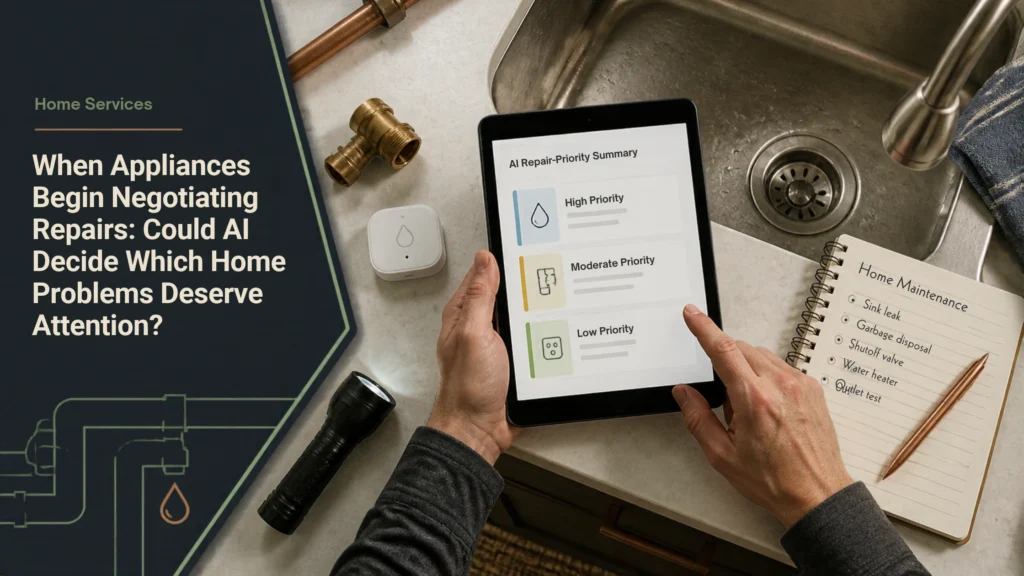
Instead of receiving separate alerts from numerous products, homeowners might see one organized maintenance overview.
The system could identify urgent concerns, explain developing performance issues, and estimate which preventive actions may be worthwhile.
It might also coordinate routine service visits to reduce scheduling conflicts.
For example, several nonurgent maintenance tasks could be grouped into a convenient appointment period when appropriate technicians are available.
However, this scenario remains a developing possibility rather than an established feature of ordinary homes.
Different manufacturers use different systems, and many appliances do not provide the detailed information necessary for advanced diagnostics.
Technical compatibility, data quality, consumer protection, and reliable automation must improve before such systems become broadly practical.
People Also Ask About AI-Powered Appliance Repairs
1. Can AI Predict Appliance Failures Before They Happen?
AI can analyze operating information such as vibration, temperature, electrical consumption, and usage patterns to identify abnormalities associated with certain equipment problems. Some predictive maintenance systems can help detect developing issues before complete failure occurs. However, predictions depend on sensor quality, available training data, and equipment conditions. AI cannot guarantee when an appliance will fail or accurately diagnose every possible malfunction.
2. Could Smart Appliances Automatically Schedule Their Own Repairs?
Future connected appliances could potentially share diagnostic information with household AI assistants that request estimates and arrange appointments. Some existing smart systems already provide maintenance notifications and limited diagnostic support. However, fully autonomous repair scheduling across different appliances and service providers is not a universal consumer capability. Homeowners should retain control over appointments, payments, and access permissions.
3. How Would AI Decide Which Home Appliance Needs Repair First?
An AI maintenance system could rank appliance problems using safety risks, performance changes, likelihood of failure, repair costs, household needs, and potential property damage. A refrigerator experiencing unsafe cooling temperatures might receive greater urgency than an appliance with a minor efficiency issue. However, these rankings would remain estimates. Safety-critical conditions require established protective procedures and professional evaluation rather than relying solely on automated predictions.
4. Will AI Replace Professional Appliance Repair Technicians?
AI is more likely to support appliance repair technicians than replace them completely. Automated systems may improve fault detection, service planning, and replacement part selection. However, many repairs require physical inspections, specialized tools, electrical or mechanical expertise, and safety verification. Skilled technicians will remain essential for confirming diagnoses and completing work that automated software cannot safely perform.
The Future of Home Repairs Could Become a Conversation Between Machines
Artificial intelligence is beginning to change how equipment problems are identified and managed.
Instead of waiting for household appliances to fail, predictive maintenance systems may help recognize unusual operating patterns and recommend earlier intervention.
The next possibility is more ambitious.
Connected appliances could exchange information, compare maintenance priorities, and help homeowners decide which repairs deserve immediate attention.
Such systems might reduce unnecessary expenses, prevent some equipment failures, and support more efficient use of household resources.
However, increasingly autonomous maintenance also creates risks involving inaccurate diagnoses, excessive notifications, manufacturer influence, privacy, and unwanted financial decisions.
The real value of intelligent appliances will not come from allowing machines to control every household repair. It will come from helping homeowners understand problems earlier and make better-informed decisions.
The most effective future systems will combine reliable data with professional expertise and clear human oversight.
A refrigerator may eventually explain why its cooling performance deserves attention before a washing machine’s minor vibration.
An AI assistant might organize repair options and recommend a reasonable schedule.
But the final measure of success will be whether these technologies make homes safer, more affordable, and easier to maintain.
The future of home maintenance may involve appliances that communicate with one another, but homeowners should remain the ones deciding what happens next.
