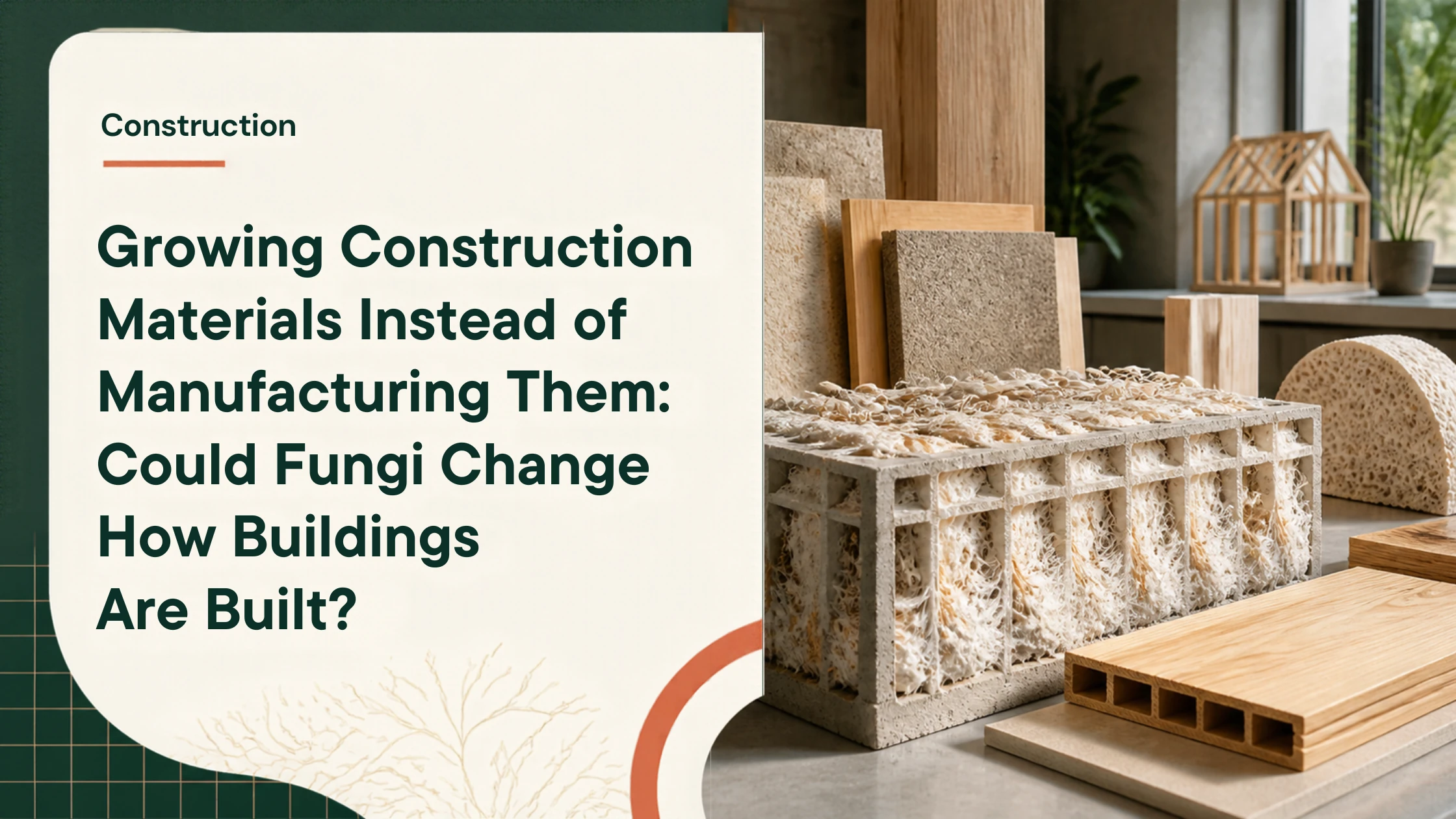
What if the next generation of building materials did not come from factories, mines, or industrial furnaces, but from something that could grow naturally?
Construction has always depended on transforming raw materials into useful products. Trees become lumber, limestone becomes cement, and minerals are processed into steel, glass, and other essential building components.
These processes have made modern construction possible, but they also require significant resources, energy, and transportation.
Now, researchers are exploring a surprisingly different approach: growing construction materials using fungi.
Rather than manufacturing every building product through conventional industrial processes, scientists can cultivate networks of fungal filaments that bind agricultural waste into lightweight, solid materials.
The resulting products, known as mycelium-based composites, are being investigated for insulation, acoustic panels, decorative surfaces, and other building applications.
Some have already appeared in experimental architectural structures. Others remain under development as researchers investigate durability, structural performance, and large-scale production.
This raises an intriguing question: Could future buildings contain materials that were grown instead of manufactured?
The answer may change how architects think about construction, waste, and the relationship between buildings and natural biological processes.
What Are Mycelium-Based Construction Materials?
Mycelium is the network of fine, threadlike structures produced by fungi.
These filaments, called hyphae, grow through suitable environments while obtaining nutrients from surrounding organic material.
Researchers have discovered that this natural growth process can help bind loose plant-based materials into cohesive structures.
For example, agricultural residues such as straw, hemp fibers, and sawdust can serve as a growing medium for selected fungi.
As the fungal network develops, it spreads through the material and connects individual particles.
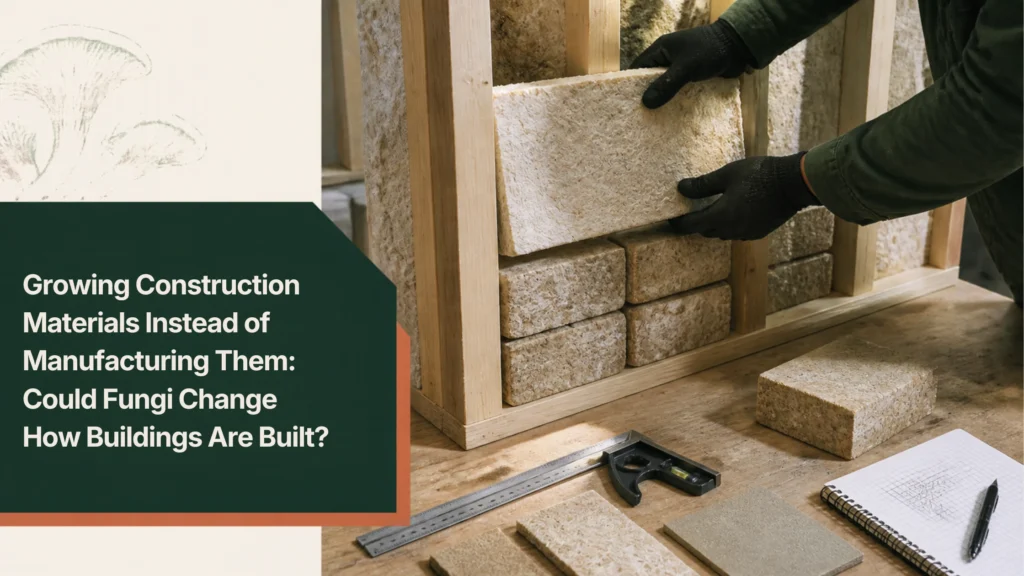
The resulting composite can be shaped into blocks, panels, or other forms.
After growing, manufacturers typically dry or heat-treat the product to stop further fungal activity and stabilize its properties.
This means finished mycelium building products are generally not living organisms continuing to grow inside buildings.
Instead, they are engineered materials created through a biological manufacturing process.
How Can Fungi Grow Into Building Materials?
Growing mycelium composites requires controlled conditions rather than simply allowing mushrooms to spread through construction waste.
Manufacturers select fungal species and plant-based materials based on the desired properties of the final product.
The production process generally involves several stages:
- Preparing the substrate: Agricultural residues are cleaned, sized, and treated as necessary to reduce unwanted microorganisms.
- Introducing the fungus: Selected fungal cultures are added to the prepared material.
- Controlling growth: Temperature, moisture, oxygen, and other conditions are managed while the mycelium develops.
- Shaping the material: Molds or other forming techniques help produce the required dimensions.
- Stopping biological activity: Drying or heat treatment stabilizes the finished composite.
- Finishing and testing: Products may be trimmed, treated, and evaluated for their intended use.
Different production methods create different material characteristics.
Some composites are lightweight and porous, while others are pressed to improve density and mechanical performance.
The process is promising because biological growth performs part of the binding work that conventional manufacturing often achieves using synthetic adhesives or other industrial methods.
Why Are Researchers Interested in Growing Building Materials?
The construction industry consumes substantial quantities of natural resources.
Cement production, steel manufacturing, mineral extraction, and conventional material processing all contribute to the environmental impact of buildings.
Mycelium composites offer a possible alternative for certain applications because they can use renewable feedstocks and agricultural byproducts.
Their biological growth process may also require less energy than some conventional manufacturing methods.
For example, cultivating a lightweight insulation panel does not necessarily require the high temperatures used to manufacture mineral-based products.
However, fungal materials still require controlled growing environments, processing equipment, and drying.
These activities consume energy.
The environmental advantage therefore depends on the entire production system, including electricity sources, transportation, material treatment, and expected service life.
Growing a material does not automatically make it sustainable. Its total environmental performance must still be demonstrated.
Could Mycelium Replace Traditional Building Insulation?
Thermal insulation is among the more practical applications being investigated for mycelium composites.
Many fungal composites contain porous internal structures that can restrict heat transfer.
Researchers have measured thermal performance that approaches the range of certain conventional insulation materials.
A 2026 systematic review reported promising insulation properties for mycelium-based composites, particularly materials combining fungal growth with plant fibers.
However, performance varies considerably depending on density, fungal species, substrate composition, and processing methods.
Moisture sensitivity remains a significant challenge.
An insulation material must maintain suitable performance throughout years of changing environmental conditions.
Researchers therefore need to evaluate whether mycelium products can retain their properties when installed within actual building assemblies.
For now, protected, non-load-bearing applications appear more practical than using these materials throughout every part of a building.
Could Fungi Create Better Soundproofing Materials?
Sound absorption is another promising application.
Mycelium composites often have porous structures that can absorb certain sound frequencies.
This makes them interesting for interior acoustic panels, ceiling treatments, and other sound-management products.
For example, a meeting room could potentially use fungal composite panels to reduce reverberation.
Restaurants, offices, and educational facilities might also benefit from appropriately designed acoustic products.
However, sound absorption and soundproofing are not the same.
An acoustic panel may reduce echoes inside a room without significantly preventing sound from traveling through a wall.
The performance of fungal composites depends on their thickness, density, internal structure, and installation method.
Researchers must also evaluate fire safety, durability, indoor air quality, and applicable construction requirements before widespread commercial use.
Are Buildings Already Being Constructed With Fungi?
Mycelium has already appeared in experimental architectural projects.
One well-known example is Hy-Fi, a temporary installation constructed in New York City in 2014.
Designed by The Living for MoMA PS1, the project used approximately 10,000 biodegradable bricks made from agricultural waste and fungal mycelium.
The installation demonstrated how biologically grown materials could form a substantial temporary architectural structure.
After the exhibition, the bricks were recovered and composted.
Another example is The Growing Pavilion, presented during Dutch Design Week in 2019.
Its exterior incorporated panels grown from mycelium and agricultural hemp residues.
These projects demonstrated creative possibilities for biological materials.
However, temporary architectural installations do not establish that mycelium products are ready to replace conventional structural systems in permanent buildings.
Could Entire Houses Eventually Be Grown From Fungi?
The idea of growing an entire house is appealing, but current mycelium technology has important limitations.
Most conventional mycelium composites have relatively low mechanical strength compared with materials such as structural steel, reinforced concrete, and engineered timber.
This restricts their use in applications requiring substantial load-bearing capacity.
A building must withstand structural loads, environmental forces, and long-term wear.
It must also meet applicable fire safety, moisture protection, and durability requirements.
Researchers are exploring methods to improve the strength of fungal materials through compression, reinforcement, and hybrid construction systems.
Future buildings might combine structural frames made from established materials with mycelium-based insulation or interior components.
That approach is more realistic in the near term than expecting an entire multistory building to be grown from fungi.
Could Mycelium Become a Self-Healing Building Material?
One particularly unusual possibility involves living fungal materials that could respond to damage.
Because living mycelium can grow and form new networks under suitable conditions, researchers are interested in whether it might contribute to self-repairing systems.
For example, an experimental material could potentially use controlled biological growth to address certain forms of minor damage.
However, this concept is substantially different from conventional dried mycelium composites.
Most finished fungal panels are processed to stop further growth.
They cannot simply regenerate when cracked or damaged.
Keeping a construction material biologically active also introduces challenges involving moisture, nutrient supply, contamination, and long-term control.
Self-healing fungal buildings therefore remain an experimental possibility rather than an established construction capability.
What Happens When Mycelium Building Materials Get Wet?
Moisture resistance is one of the biggest technical obstacles facing fungal construction materials.
Many mycelium composites contain plant fibers and porous structures that can absorb water.
Excessive moisture may affect their dimensions, strength, and durability.
In unsuitable conditions, damp organic materials may also support unwanted microbial growth.
Researchers are investigating coatings, material formulations, and processing methods intended to improve moisture resistance.
However, protective treatments may affect biodegradability and environmental performance.
For example, a coating that significantly improves water resistance could complicate composting or recycling at the end of a product’s life.
This creates a design tradeoff.
Building materials must survive expected environmental exposure while still delivering the sustainability advantages that make them attractive.
Are Mycelium Construction Materials Fire Resistant?
Some research indicates that properly formulated mycelium composites can exhibit favorable fire behavior compared with certain synthetic foam materials.
Their chemical composition and tendency to form char may influence how they respond to heat.
However, fire performance varies with fungal species, substrate, density, additives, and manufacturing methods.
It would be inaccurate to describe every mycelium product as fireproof.
A building product must undergo appropriate testing for its intended use.
Fire resistance requirements also differ between insulation, interior finishes, wall assemblies, and structural components.
A material performing well in a laboratory test may still require additional evaluation when installed as part of a complete building system.
Commercial adoption depends on verified performance rather than general claims about natural fire resistance.
Could Agricultural Waste Become a Source of Construction Materials?
One advantage of mycelium composites is their potential to use agricultural residues.
Crop production and food processing generate substantial quantities of fibrous materials.
Some of these byproducts can serve as substrates for fungal growth.
Examples include:
- Straw from grain production
- Sawdust and selected wood residues
- Hemp processing byproducts
- Corn stalks and other crop residues
- Certain coffee-processing residues
Using these materials could create additional markets for agricultural waste.
For example, a regional manufacturer might obtain suitable residues from nearby farms and convert them into lightweight panels.
However, waste availability varies seasonally, and residues may already have agricultural or industrial uses.
Reliable manufacturing also requires consistent material quality.
Future production systems must consider whether feedstocks are economically available without creating unexpected environmental or supply-chain problems.
Could Mycelium Reduce Construction Waste?
Mycelium products may contribute to circular construction because they can incorporate recovered biological materials.
Some formulations may also be biodegradable under suitable conditions.
This creates the possibility of building products that return to biological material cycles after use.
However, biodegradability is not automatic for every finished product.
Coatings, synthetic reinforcements, adhesives, and other additives may change disposal requirements.
Similarly, a product that degrades easily is not necessarily suitable for a building expected to last several decades.
Manufacturers must balance durability during use with appropriate end-of-life treatment.
A successful circular material should remain reliable throughout its intended service life and have a practical recovery or disposal pathway afterward.
Could Growing Materials Become Cheaper Than Manufacturing Them?
Mycelium composites may reduce dependence on certain expensive raw materials or manufacturing processes.
Agricultural residues can sometimes be obtained at relatively low cost.
However, commercial production involves additional expenses.
Controlled growing environments require equipment, space, energy, and quality monitoring.
Fungal growth also takes time.
Manufacturers must manage contamination risks, maintain consistent dimensions, and process finished products before distribution.
Drying can require significant energy.
Conventional materials benefit from mature manufacturing systems and established supply chains.
Mycelium products must compete with these advantages while meeting the same relevant performance requirements.
Their future affordability will depend on production efficiency, scale, transportation, and market demand.
Could Construction Factories Eventually Resemble Farms?
Biological manufacturing may change how certain construction materials are produced.
Instead of relying entirely on high-temperature industrial processing, future facilities could combine agricultural feedstocks with controlled fungal cultivation.
Specialized production rooms might manage humidity, temperature, airflow, and growth cycles.
Robotics could potentially assist with mold preparation, handling, and quality inspection.
Digital monitoring might identify changes that affect product consistency.
However, these facilities would still be manufacturing operations requiring technical oversight.
The biological process would replace selected stages of conventional production rather than eliminate industrial infrastructure entirely.
This combination of cultivation and engineering could create a new category of building-material manufacturing.
Why Is NASA Interested in Fungal Construction Materials?
The potential applications of mycelium extend beyond Earth.
NASA has supported research into mycotecture, an approach that explores growing useful structures from fungal materials.
The concept is particularly interesting for space exploration because transporting construction supplies from Earth requires considerable resources.
Researchers have investigated whether lightweight biological systems could help produce selected structures or components after reaching another destination.
Fungi may offer possibilities for manufacturing materials from suitable locally available or transported feedstocks.
However, fungal habitats on the Moon or Mars remain experimental concepts.
They face challenges involving radiation, environmental control, water availability, structural safety, and reliable biological growth.
NASA’s interest demonstrates the technology’s imaginative potential, not evidence that fully grown fungal homes are ready for extraterrestrial construction.
What Needs to Happen Before Fungal Materials Become Mainstream?
Research has demonstrated that mycelium composites can produce useful material properties.
The next challenge is translating laboratory results into reliable commercial construction products.
Important areas requiring further development include:
- Consistent manufacturing and quality control
- Improved moisture resistance
- Verified fire performance
- Long-term durability testing
- Appropriate mechanical strength
- Cost-effective large-scale production
- Environmental life-cycle assessments
- Building-code acceptance and product certification
Architects and engineers also need dependable technical information.
Without standardized performance data, selecting mycelium products for construction remains difficult.
The most likely near-term opportunities involve acoustic panels, interior products, and carefully designed insulation applications.
Broader structural uses will require considerably more research and engineering development.
People Also Ask About Mycelium and Fungal Construction Materials
Can mushrooms really be used to build houses?
Fungal mycelium can be grown into lightweight composite materials suitable for certain building applications. Experimental structures have used mycelium bricks and panels. However, conventional fungal composites are not currently established replacements for the main load-bearing systems of permanent houses.
How are mycelium building materials made?
Manufacturers combine selected fungi with suitable plant-based substrates under controlled growing conditions. As the mycelium develops, it binds the particles together. The material is then shaped, dried or heat-treated, and processed into products such as panels or blocks.
Are mycelium bricks as strong as concrete?
Generally, no. Conventional mycelium bricks have substantially different mechanical properties and are not equivalent to structural concrete. Researchers are investigating reinforcement and processing methods, but standard fungal composites are currently better suited to selected non-load-bearing applications.
Can mycelium insulation replace fiberglass?
Mycelium-based insulation has shown promising thermal performance in research. However, moisture resistance, durability, fire testing, manufacturing consistency, and regulatory approval remain important challenges. It cannot be assumed to replace fiberglass in every building application.
Will fungal building materials grow mold inside walls?
Finished mycelium composites are generally dried or heat-treated to stop fungal growth. However, like other susceptible building materials, they may experience moisture-related problems if installed or maintained improperly. Their suitability depends on product design and effective moisture control.
Are mycelium building materials biodegradable?
Many mycelium composites contain biodegradable biological ingredients. However, actual disposal characteristics depend on processing, coatings, additives, and environmental conditions. A finished product should not automatically be considered compostable without evidence supporting that claim.
Can mycelium buildings repair themselves?
Self-healing fungal materials are an area of experimental research. Most commercially relevant mycelium composites are processed to stop biological activity and cannot regenerate after damage. Reliable self-repairing fungal building systems have not been established for ordinary construction.
Could fungi replace concrete and steel in future construction?
Fungi may provide alternatives for selected insulation, acoustic, and interior applications. However, concrete and steel perform essential structural functions that conventional mycelium composites cannot currently replace. Future buildings may use fungal materials alongside established structural systems rather than replacing them entirely.
Could the Future of Construction Be Grown Instead of Built?
Construction materials have traditionally been manufactured through extraction, processing, heating, and mechanical transformation.
Mycelium introduces another possibility.
By using the natural growth of fungi, researchers can transform selected agricultural residues into materials with potentially useful insulation, acoustic, and environmental properties.
Experimental buildings have already demonstrated what biologically grown products can achieve.
However, significant limitations remain.
Moisture sensitivity, inconsistent mechanical performance, long-term durability, and commercial production costs continue to restrict their applications.
These challenges do not make fungal construction irrelevant.
They help clarify where the technology may provide meaningful benefits.
Rather than replacing every traditional building product, mycelium could become one component of a broader shift toward resource-efficient and biologically derived materials.
Future construction may combine conventional engineering with processes inspired by the natural world.
Because the most important change may not be learning how to grow entire buildings. It may be discovering that some of the materials we manufacture today could be produced more efficiently by allowing nature to do part of the work.
